Blog

Backlinks vs. DataPins: Local SEO Case Study

DP
DATAPINS
Case Study · 2026
Plumbing Industry · Jupiter, FL Backlinks vs.
DataPins
A Local SEO Case Study
Drain to Drain (a DataPins user) launched in August 2023 with a brand-new domain, has 31 backlinks, and a domain authority of 8. Two established competitors held 10–28× more domain age, 26–384× more backlinks, and far greater authority — yet Drain to Drain outranked both across Map Pack and organic search.
Subject Drain to Drain
Market Jupiter, FL + 6 Cities
Keywords Tracked 210+ Queries
DataPins Published 382 Pins
Scroll
Three Sites.
One Winner.
On paper, Drain to Drain had no business competing — a 2-year-old domain against established local and national plumbing brands with decades of authority. The data tells a different story.
Drain to Drain DataPins User · draintodrain.com
Competitor 1 Local Plumber · Est. 2014
Competitor 2 National Franchise · Est. 1997
Competitor 1
DataPins 0
Domain Age 12 years
Domain Authority 21
Backlinks 811
Google Reviews 300
Map Pack Avg #1.90
Organic Avg #5.03
Competitor 2
DataPins 0
Domain Age 28 years
Domain Authority 61
Backlinks 11,900
Google Reviews 1,048
Map Pack Avg #2.00
Organic Avg #4.31
The Key Numbers
#1.67 Average Map Pack position for Drain to Drain — beating Competitor 1 (#1.90) and Competitor 2 (#2.00) Map Pack Winner
#2.81 Average organic ranking — nearly 2× better than Competitor 1 (#5.03) and Competitor 2 (#4.31) Organic Winner
384× More backlinks held by Competitor 2 (11,900 vs 31) — yet Drain to Drain ranked higher on both surfaces Authority Paradox
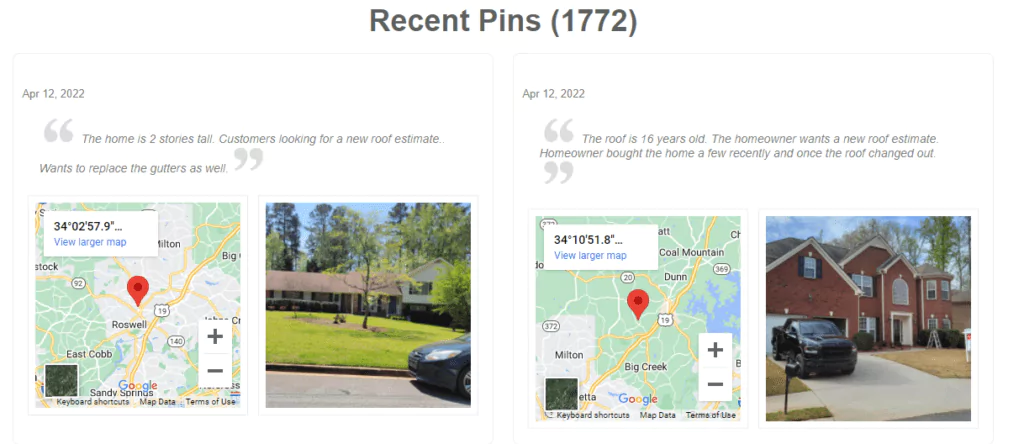
382 DataPins published by Drain to Drain — geo-tagged, schema-rich job check-ins documenting real work across 7 cities Digital Brand Signals
Map Pack Avg Ranking (Lower = Better)
Drain to Drain
#1.67
Competitor 1
#1.90
Competitor 2
#2.00
Organic Avg Ranking (Lower = Better)
Drain to Drain
#2.81
Competitor 1
#5.03
Competitor 2
#4.31
Backlinks (Higher = More Authority)
Drain to Drain
31
Competitor 1
811
Competitor 2
11,900
Domain Authority
Drain to Drain
DA 8
Competitor 1
DA 21
Competitor 2
DA 61
Full Metric
Comparison
Every measured signal across all three sites. Green values indicate the leading figure for that metric.
Metric Drain to Drain Competitor 1 Competitor 2
DataPins Published Geo-tagged job check-ins with schema markup 382 ↑ Only user 0 0
Map Pack Avg Ranking Avg position across all tracked keywords · lower = better #1.67 ↑ Best #1.90 #2.00
Organic Avg Ranking Avg position across all tracked keywords · lower = better #2.81 ↑ Best #5.03 #4.31
Domain Authority Moz DA · higher = stronger link profile 8 21 61
Backlinks Total inbound links from external domains 31 811 11,900
Google Reviews Total Google Business Profile reviews 310 300 1,048
Domain Age Years since domain registration 2 years 12 years 28 years
Where Drain to Drain
Dominates
A sample of high-value queries where the rankings tell the clearest story. Map Pack positions shown.
drain cleaning jupiter fl Map Pack
Drain to Drain #1
Competitor 1 Unranked
Competitor 2 #2
hydro jetting jupiter fl Map Pack
Drain to Drain #1
Competitor 1 Unranked
Competitor 2 Unranked
badger 5 garbage disposal repair jupiter fl Map Pack + Organic
Drain to Drain #1 / #1
Competitor 1 Unranked
Competitor 2 Unranked
sewer line repairs jupiter fl Map Pack + Organic
Drain to Drain #1 / #5
Competitor 1 Unranked
Competitor 2 Unranked
toto toilet installation jupiter fl Map Pack
Drain to Drain #1
Competitor 1 #2
Competitor 2 Unranked
commercial hydro jetting service jupiter fl Map Pack + Organic
Drain to Drain #3 / #1
Competitor 1 Unranked
Competitor 2 Unranked
drain cleaning north palm beach fl Map Pack
Drain to Drain #1
Competitor 1 Unranked
Competitor 2 Unranked
quarter turn hose bib installation jupiter fl Map Pack + Organic
Drain to Drain #1 / #1
Competitor 1 #1 / Unranked
Competitor 2 Unranked
Study Methodology Rankings, authority data, and site metrics were captured at a single point in time and compared across the three plumbing businesses serving the Jupiter, FL metro area.
01 Site Selection Drain to Drain was selected as the DataPins user subject. Two competing plumbing businesses with Google Business Profile addresses in the same city — one local, one national franchise — were chosen as the comparison group based on geographic market overlap.
02 Keyword Tracking Over 210 keyword queries were tracked across 7 cities: Jupiter, Tequesta, Jupiter Island, Juno Beach, Palm Beach Gardens, North Palm Beach, and Hobe Sound. Map Pack and organic positions were manually recorded from public Google search results using localized queries.
03 Authority Data Domain Authority and backlink counts were sourced from Moz’s publicly available link metrics. Google review counts were pulled from each business’s Google Business Profile. Domain registration dates were verified via public WHOIS records.
04 DataPins Count Total published pins were recorded from the Drain to Drain “pins” page at the time of the study. Each pin represents a geo-tagged, schema-marked job check-in published to the site.
Key Takeaways What this single-site case study suggests about how Google may weigh local relevance signals against traditional domain authority.
📍
382 Pins Beat 11,900 Backlinks Competitor 2 held 384× more backlinks and a DA of 61 versus Drain to Drain’s DA of 8 — yet ranked lower on both Map Pack and organic for this sampling of local queries. The geo-tagged job signal corpus Drain to Drain built through DataPins appears to carry more local relevance weight than raw link authority.
🗺️
Hyper-Specific Keywords Are Where DataPins Shines On brand-and-model keywords like “Badger 5 garbage disposal repair Jupiter FL” and “Rheem 75 gallon natural gas water heater installation,” Drain to Drain ranked #1 in both Map and organic while both competitors were entirely absent. These are exactly the types of queries DataPins generates content for automatically.
📐
Geographic Expansion Without Separate GBPs Drain to Drain ranked in the Map Pack for drain cleaning and hydro jetting in Tequesta, Jupiter Island, Juno Beach, Palm Beach Gardens, North Palm Beach, and Hobe Sound — without having an address in those cities. The geo-tagged pins appeared to have created a proximity and relevance signal across a roughly 10 mile radius.
🚀
A 2-Year-Old Domain Can Win in Competitive Markets Domain age is often cited as an insurmountable advantage for established players. Drain to Drain launched in August 2023 and within two years achieved better average rankings for these queries than a 12-year-old local competitor and a 28-year-old national brand.
A 2-year-old plumbing site with 31 backlinks outranked a national franchise with 11,900. In this comparison, a DataPins-powered website ranked higher than competitors with dramatically stronger backlink profiles, suggesting that backlinks are not necessarily more important than DataPins for local SEO performance. DataPins Research Team · 2026 · Jupiter, FL Observational Case Study
How This Plumber Shifted Local SEO With Unique Content


Local plumbing companies that have spent years, and even decades, investing in “local SEO” have been noticing a sharp decline in calls, leads, and clicks for a variety of reasons.

Search engine results are rapidly changing, AI is disrupting everything from algorithms to consumer behavior, and plumbing websites are being quietly devalued with each algorithm update.

If we were to pinpoint one structural problem with local SEO for plumbers, it would be the industry’s overreliance on commodity content.


Local SEO for Plumbers

Why Commodity Content No Longer Works for Local SEO

Commodity content has been a longstanding problem for Google for more than a decade, and its affliction has expanded to specific verticals, especially plumbing. 

Think about your mass-produced city pages and generic, regurgitated blog posts, such as 3 ways homeowners should protect against plumbing damage.

This objectively low-value content, and Google’s algorithms, especially their AI variants, are becoming increasingly adept at filtering it out in favor of better alternatives.


Danny Sullivan recently spoke about this issue at the Google Search Central event in Toronto.

That’s why the phrasing “local SEO for plumbers” has introduced a vast array of agencies selling the same recycled playbook: blog posts about drain cleaning, city pages with swapped zip codes, and backlink packages to contractors who have no way of knowing the strategy stopped working years ago.

The plumbing vertical is particularly vulnerable to this because the services are largely the same from one company to the next. Every plumber fixes leaks, clears drains, and installs water heaters. 


The commodity content problem is not just a Google algorithm issue for plumbers; it reflects how undifferentiated most plumbing businesses appear online, because the agencies serving them have no mechanism for publishing anything that isn’t interchangeable.

What follows is not a collection of tips. It is data from a real plumbing company competing in a real market against real competitors, and what happened when jobsite documentation replaced generic content as the primary SEO signal.


What Plumber Should Ask Their Local SEO Agency

Most local SEO conversations for plumbers start with Google Business Profile “optimization,” content volume, and backlinks. These are the metrics agencies know how to sell because they are easy to invoice against. Added x number of services to your GBP. Publish 10 pages this month. Build 15 links this quarter.

The problem is that none of those metrics address how modern search works. For example, a 2-year-old plumbing website with 31 backlinks can outrank a national franchise with 11,900 using the right strategy.


31 Backlinks vs. 11,900: What the Data Actually Shows

Drain to Drain is a plumbing company serving Jupiter, FL and surrounding cities. They launched on a brand-new domain in August 2023 and began using DataPins to document their jobs as geo-tagged, schema-rich check-ins published directly to their website.

At the time of the study, their profile looked like this on paper: domain authority of 8, 31 backlinks, a domain that was two years old. By the metrics most agencies use to forecast SEO success, they had no business competing for top positions in a market that included a 12-year-old local competitor and a national franchise that has been online since 1997.

The national franchise held a domain authority of 61 and 11,900 backlinks, 384 times more than Drain to Drain. The local competitor held 811 backlinks and a 12-year head start on domain age.


Across 210+ tracked keyword queries in 7 cities, Drain to Drain achieved an average Map Pack position of #1.67. The local competitor averaged #1.90. The national franchise averaged #2.00.

On organic, the gap was wider. Drain to Drain averaged #2.81. The local competitor averaged #5.03. The national franchise averaged #4.31.

The queries where the difference is sharpest are the brand and model-specific ones. For “Badger 5 garbage disposal repair Jupiter FL,” Drain to Drain ranked #1 in both Map Pack and organic.


Both competitors were entirely absent. For “hydro jetting Jupiter FL,” Drain to Drain ranked #1 in the Map Pack. Both competitors were unranked. For “quarter turn hose bib installation Jupiter FL,” Drain to Drain held #1 in both surfaces. The national franchise did not appear.

These are not obscure vanity keywords. They are the exact queries a homeowner types when they know what they need, and they are ready to call. Drain to Drain owned them. The competitors, despite their substantial authority advantages, had no content that matched the specificity of the search.

That specificity came from 382 DataPins check-ins documenting real jobs. Every service call, every fixture brand, every material, every city, published to the website at the time of the job. No competitor can replicate that content without doing the work themselves, which is precisely the point.


DataPins Case Study — Drain to Drain
Backlinks: 384x the authority,
0x the rankings

Drain to Drain DataPins user • DA 8
31
Local Competitor 12-year-old domain
811
National Franchise DA 61 • online since 1997
11,900
Drain to Drain ranked #1 across 210+ keywords

Bar width scaled to backlink count. Drain to Drain’s bar is intentionally nearly invisible — it held 31 backlinks versus the franchise’s 11,900, yet achieved a superior average Map Pack position of #1.67.


What Happens at the AI (AEO/GEO) Layer?

The backlink comparison documents what DataPins does for traditional search. The Drain to Drain “Impossible 4” result documents what it does when the content signal is strong enough to register across every surface Google offers simultaneously.

After beginning DataPins usage in February 2025, Drain to Drain ranked for what is effectively an unrepeatable SERP result on a single pin-driven query: AI Overview, AI Overview Citation #1, Featured Snippet, and Knowledge Panel, all at once, for the same search.

Capturing any one of these placements is a meaningful win for a local contractor. Capturing all four on a single query has no established precedent.


In the same 60-day window, their website traffic increased 498.6%.

Beyond Google, Perplexity.AI began recommending Drain to Drain in answers based on specific pins. This is how AI synthesis works for local service businesses: the platform reads the jobsite documentation, identifies it as relevant and specific, and surfaces the company as a local authority.

Generic content about drain cleaning does not produce that result. A documented drain cleaning job at a specific address, with specific materials and a technician caption, does.


The distinction matters because AI platforms are not ranking pages the way Google’s traditional algorithm does. They are synthesizing sources they consider credible and specific. Commodity content gets consumed and summarized without attribution. Documented jobsite content gets cited by name.


The “Impossible 4” — Single Query Result

Four SERP Placements.
One Search.

Achieved by Drain to Drain within 60 days of beginning DataPins usage (Feb 2025). No established precedent for a local contractor capturing all four simultaneously.

AI Overview Google’s AI-generated summary block
WON
AI Overview Citation #1 Top source cited within the AI Overview
WON
Featured Snippet Position zero — answer box above results
WON
Knowledge Panel Business entity panel on the right rail
WON
498%
Website Traffic Increase Within the same 60-day window after
DataPins usage began
382
DataPins Check-ins Geo-tagged, schema-rich job
documentation published to site
🌏
Beyond Google: Perplexity.AI began recommending Drain to Drain in answers based on specific pins. AI platforms cite documented jobsite content by name — generic content gets summarized without attribution.

The Local SEO Alternative to City (Doorway) Pages

The most practically significant finding in the Drain to Drain data is geographic. Plumbers do not work out of one address.

They drive to jobs across a service area that can span dozens of cities, and ranking in the Map Pack for those cities without a physical address in each one has historically required either separate GBP listings (which Google discourages) or city landing pages (which Google has been discounting).

Drain to Drain ranked in the Map Pack for drain cleaning and hydro jetting in Tequesta, Jupiter Island, Juno Beach, Palm Beach Gardens, North Palm Beach, and Hobe Sound; six cities beyond their registered location, without a separate GBP in any of them.

The geo-tagged pins documenting jobs completed in those cities created the proximity and relevance signal that extended their map presence across roughly a 10-mile radius.


This is not a workaround or a loophole. It is the logical result of publishing documented proof that you did the work in those locations. Google’s systems are designed to reward exactly that kind of first-party, location-specific evidence.

The agencies still building cookie-cutter city pages for plumbers are engineering a facsimile of the same signal, and Google has spent the better part of four years learning to tell the difference.


For a plumber, the implication is direct: every job completed in a city you want to rank in is a local SEO asset, provided it gets documented.

DataPins is the mechanism that converts the job into the asset automatically, at the moment the work is done, without requiring a writer to reconstruct it later from a service ticket.

The two-year-old domain with 31 backlinks did not beat the national franchise by finding a smarter agency. It beat them by having a documented record of real work that no amount of link building could replicate.


210+ Tracked Keywords • 7 Cities

Average Ranking Position by Competitor

Lower number = better rank. Based on Drain to Drain study data.
● Map Pack

1
Drain to Drain 382 DataPins check-ins
#1.67
2
Local Competitor 811 backlinks, 12-yr domain
#1.90 avg
3
National Franchise 11,900 backlinks, DA 61
#2.00 avg

○ Organic Search

1
Drain to Drain 382 DataPins check-ins
#2.81
2
National Franchise 11,900 backlinks, DA 61
#4.31 avg
3
Local Competitor 811 backlinks, 12-yr domain
#5.03 avg

Specific Queries Won

“Badger 5 garbage disposal repair Jupiter FL” — #1 Map Pack + Organic. Competitors: absent.

Geographic Reach

Ranked in 6 cities beyond registered location with no additional GBP listings — geo-tagged pins only.


What This All Means for Local Plumbers

Local SEO is no longer a commodity game, meaning blog posts such as 4 signs your sink is clogged are a waste of time and resources. The same is true of mass-produced city pages, which frequently match Google’s documentation on doorway pages.

While you still need to achieve your local SEO fundamentals, such as creating a Google Business Profile and getting reviews, your local content strategy must evolve to demonstrate first-hand experience and expertise.

With this in mind, you should no longer be asking your agency for “Deliverables” in the form of commoditized content, as it can do more harm to your website than anything positive.

Instead, your campaign should focus on content that showcases your recent plumbing jobs and introduces first-hand accounts of your experiences with various plumbing jobs.


Check out our local SEO software for plumbers for help transitioning away from commodity content.


Map Pack SEO: Guide to Ranking in Google’s Local 3-Pack


Research indicates that Google’s Local Map 3-Pack receives between 40% and 50% of total clicks for local intent searches.

If your business appears among the three listings included in the pack, it can significantly boost local SEO performance.

The measures your business takes to secure one of these coveted spots on Google’s local search engine results pages is called Map Pack SEO.


The following guide outlines specific actions your business can take to improve Local Map 3-Pack visibility and highlights the best practices for Map Pack SEO in 2025.


Key Takeaways

  • Google’s Map 3-Pack receives between 40% and 50% of local clicks
  • Appearing in Google’s Map Pack can significantly boost local SEO performance
  • The measures a business takes to increase Map 3-Pack visibility are called Map Pack SEO
Map Pack SEO

What is the Google Map Pack?

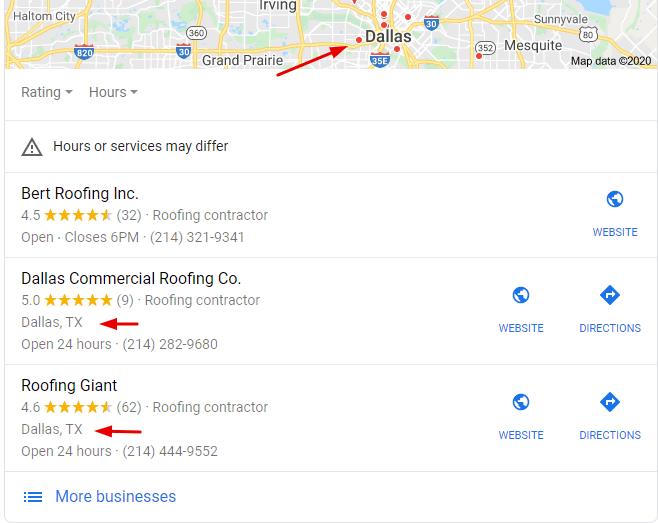
The Google Map Pack is a set of three business listings that appear at the top of Google’s search results for location-based queries.

This Google SERP feature, also known as the local pack or map 3-pack, is coveted by small businesses as it directly impacts online visibility and lead generation.

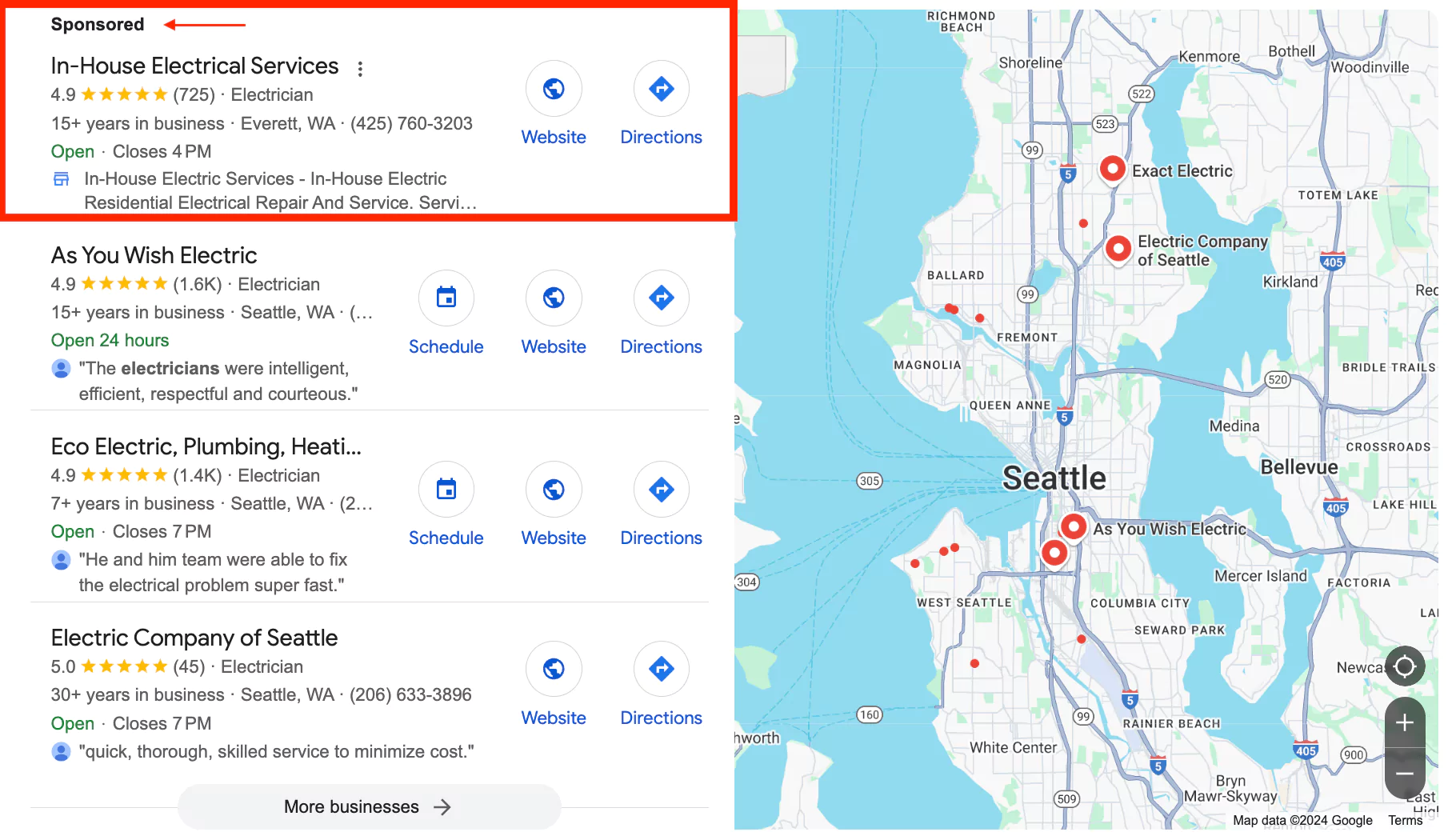
The map pack features organic results, not sponsored listings, making it part of a business’s broader SEO strategy rather than a paid advertising campaign.


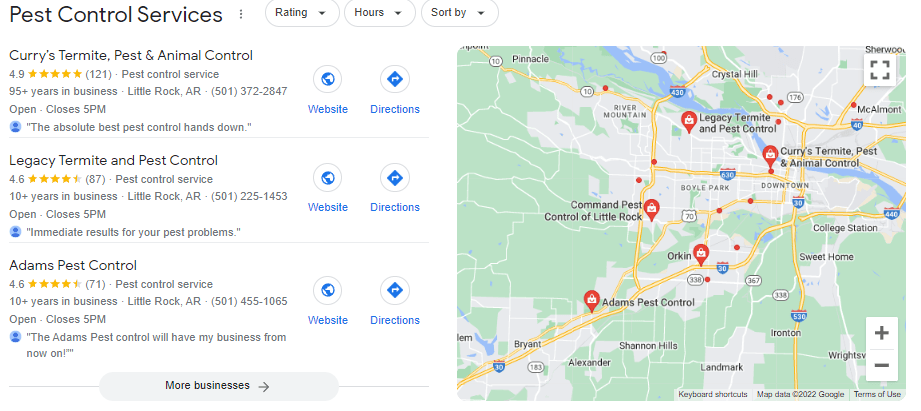
Map Pack SEO Example

Why Local Businesses Covet Map Pack Rankings

We noted that the map pack receives between 40% and 50% of total clicks for local intent searches, which is enough in itself to appeal to local businesses looking to generate leads online.

But aside from that obvious benefit, map pack visibility also helps legitimize a business by showing users verified customer reviews and contact information, leading to increased brand trust and recognition.

Another clear perk of ranking in this feature is its convenience for mobile users, who can quickly “click to call” your business directly from the local pack.


How Google Ranks Businesses in the Local Map Pack

Google’s map pack ranking algorithm is separate from its standard organic algorithm. However, many of the best practices for your website-based SEO strategy will also benefit your Google Maps SEO campaign.

The map pack algorithm itself has three primary ranking factors: relevance, distance, and prominence.


Relevance

Relevance is how well a Google Business Profile (GBP) matches the searcher’s intent. Fully completing your GBP with specific details can expand your relevance to more users.

However, don’t falsify your business name with keyword stuffing, as Google is likely to flag and suspend your listing.


Distance

Distance, often called proximity in this context, is the distance between your Google Business Profile address and the searcher’s projected location.

Although this algorithmic factor is primarily suited for storefront businesses, it still applies to service-area businesses.

Influencing the distance ranking factor is as simple as choosing a central business location within your primary service area.

However, don’t get any ideas about using a virtual location or any fake address, as Google’s automated systems can detect and penalize these actions by removing your listing from search.


Prominence

Prominence is how well-known your brand or business is to searchers.

Factors that can influence prominence include customer reviews, repitable backlinks to your website, and how frequently your brand name is searched on Google.


Optimizing Your Google Business Profile

The first and most important thing you must do to appear in the map pack is get listed on Google Business Profile.

Getting set up is free, though you will have to go through a verification process. You can get started here


Complete Every Section of Your Profile

Once you are listed, start filling out your profile with a concise description of your business, the areas you serve, the services you offer, your hours of operation, and accurate contact information.

Don’t forget to include a link to your main website, as your website-based SEO will directly influence your map 3-pack visibility.


Maintain Consistency Across All Platforms

Your NAP (name, address, and phone number) is like a digital ID for your local business. Citations help verify and disseminate that identification.

Directories like Yelp and Angi and social media platforms like Facebook and LinkedIn create NAP citations for your local business.

Off-page citations are any mention of your business or website anywhere other than your own website. The more of these citations you have, the more signs point to your website.


Keep Your Profile Fresh and Updated

Once you have everything set up, don’t just leave your profile idle. Instead, try to update it as often as possible. For example, if your company just started servicing a new area, add it to your profile.

In addition, people will be able to leave reviews of your business on your Google Business Profile, so be sure to respond to those reviews as much as possible. 

Remember that Google loves fresh content, so keep your Business Profile updated as much as possible.


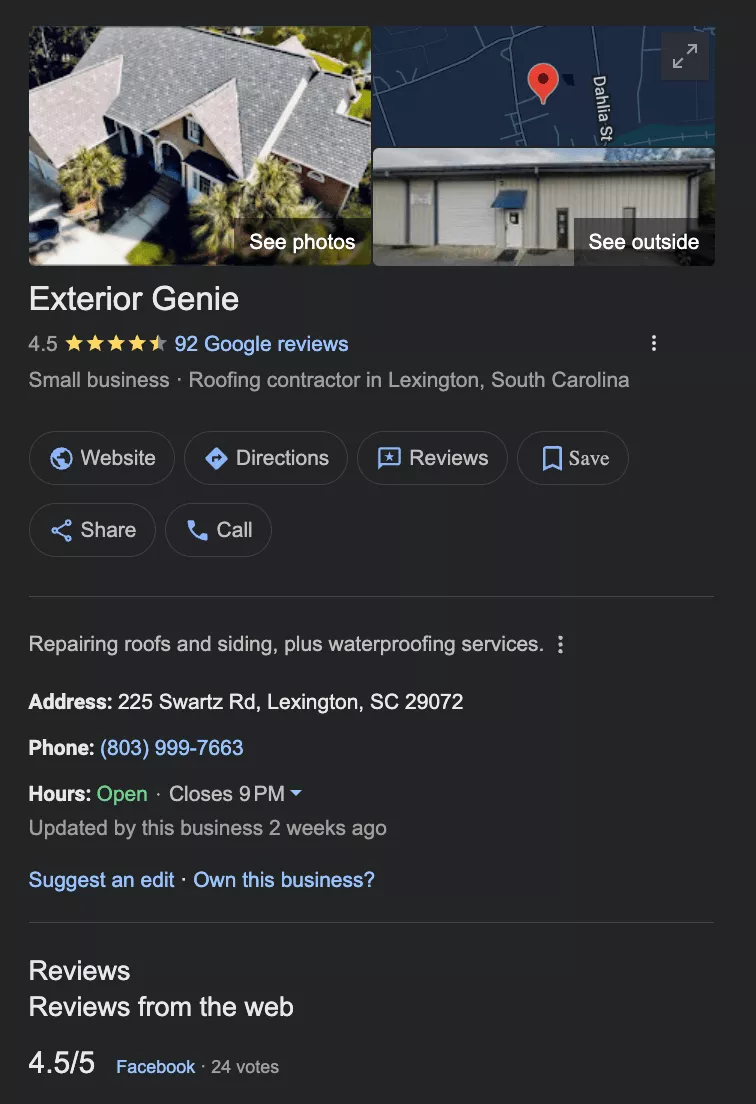
Screenshot of Local Google Business Profile

Add High-Quality Photos and Videos

Uploading original photos and videos of your staff, building, and services significantly boosts your profile’s quality.

Well-lit, in-focus photos in PNG or JPEG format perform best on Google and influence users’ decisions about whether to use your services.

Your cover photo should be 1024 x 576 px, while staff photos should be 720 x 720 px.


Getting More Google Reviews to Boost Map Pack SEO

It’s essential to get as many Google reviews as possible for your listing, and to keep doing so even if you’ve secured hundreds or even thousands of customer reviews.

Various software tools exist to send automated requests to your customers via SMS and email, helping boost response rates.

In addition, personally ask all your customers for a review after finishing a job. The majority of consumers will submit feedback if requested multiple times.


How to Respond to Google Reviews

When you notice a negative review, reply professionally and attempt to resolve the issue offline.

Customers will often remove the review or change it to a positive one if they feel that their grievance has been acknowledged or resolved.

You never want to get into an argument or trade insults with a customer, as it reflects poorly on your business, even if you’re objectively in the right.

You should also respond to positive reviews by thanking your customer for their business and encouraging them to use your services again.


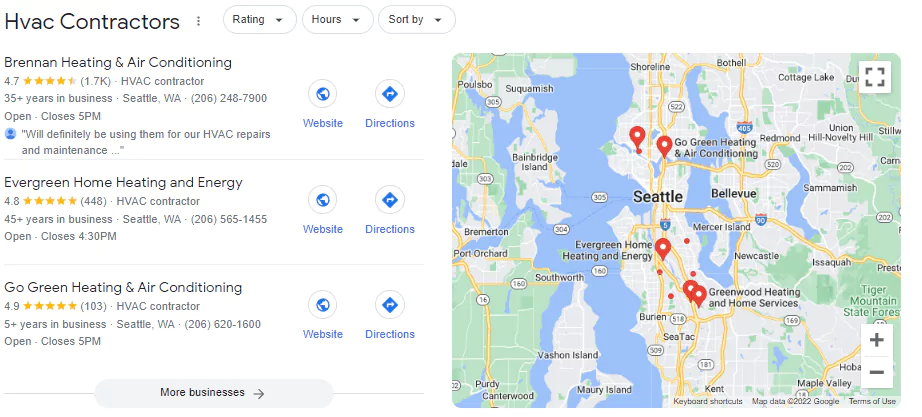
Seattle HVAC Company Map Results

Website SEO Strategies for Local Map Rankings

Standard SEO overlaps with Map Pack SEO via local website content. However, to utilize this method, you must include your website URL within your Google Business Profile under the website field.

Once you’ve connected your website to your Google Business Profile, your website’s content can start influencing your Map Pack rankings.


Publish Location Pages

Let’s say you operate a roofing company in Fort Worth, Texas. It’s relatively straightforward to appear in the Map Pack in Fort Worth.

However, showing up in nearby cities like Southlake and Grapevine requires publishing individual city pages.

The key to creating successful city pages is writing unique, locally driven content. Google’s algorithm is far too sophisticated to provide you credit for duplicate content pages.


Connect a Local Landing Page to Your Business Listing

Adding a local landing page or a service page can improve your Google Maps rankings for related queries. Google associates your website’s content with your Google Business Profile.

For example, say you run a plumbing business in Akron, Ohio. Whenever someone searches for plumbers in Akron, Google crawls websites associated with nearby map listings to find plumbing-related information.


Add Local Business Schema

Schema markup is a structured data format injected into your homepage’s HTML code. It provides Google with context about your local business.

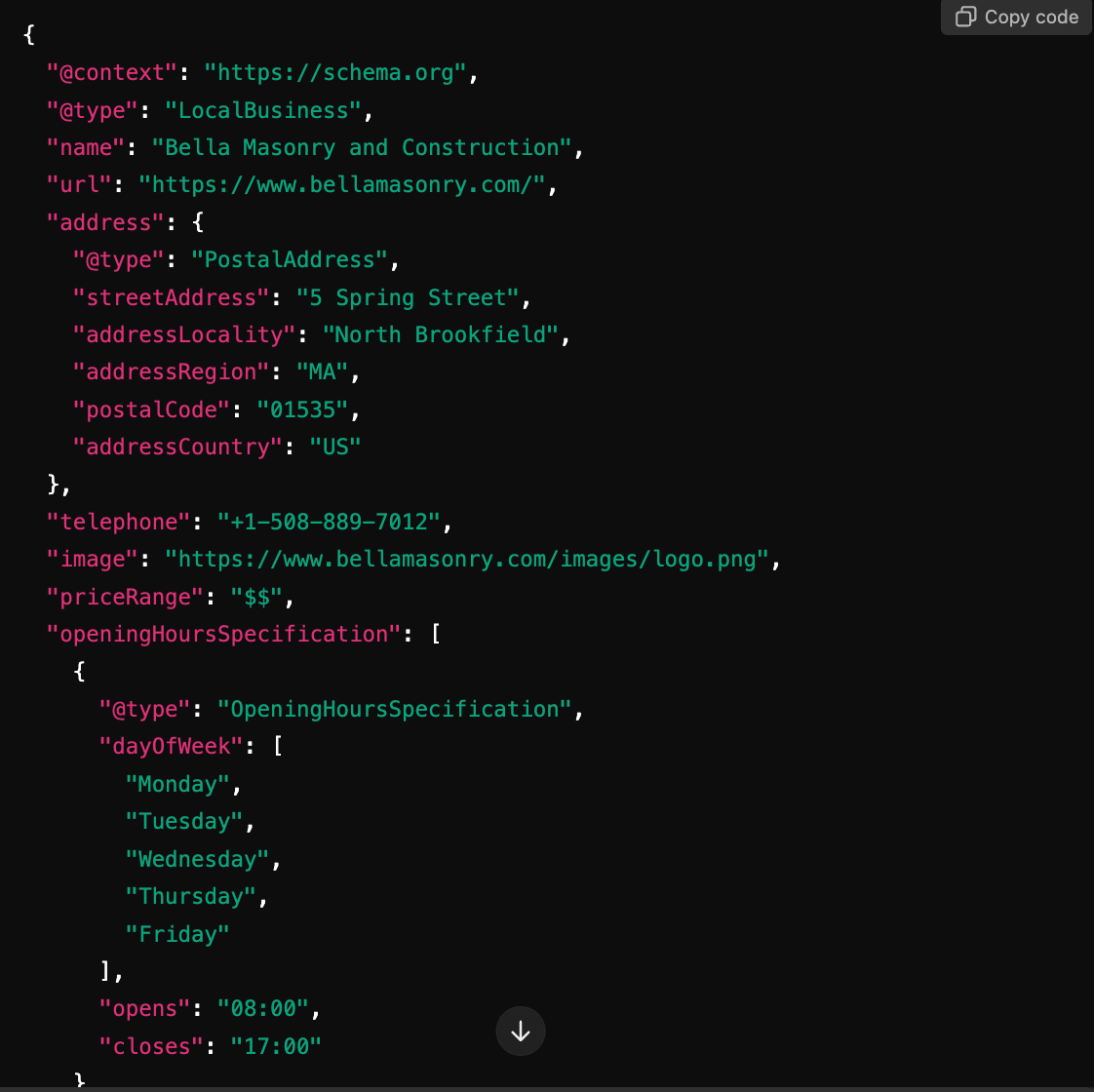
The LocalBusiness Schema helps you mark up business information, including your website URL, business name, address, phone number, and hours of operation.

Because Google scans the website URL associated with your GBP, the schema’s impact can extend to your Google Maps rankings.


Local Business Schema Example

Demonstrate Website E-E-A-T

Google’s objective is to show users legitimate, trustworthy businesses and avoid showing spam, which makes its E-E-A-T acronym highly relevant to local businesses.

E-E-A-T stands for experience, expertise, authoritativeness, and trustworthiness, and can be showcased on your business website (connected to your GBP).

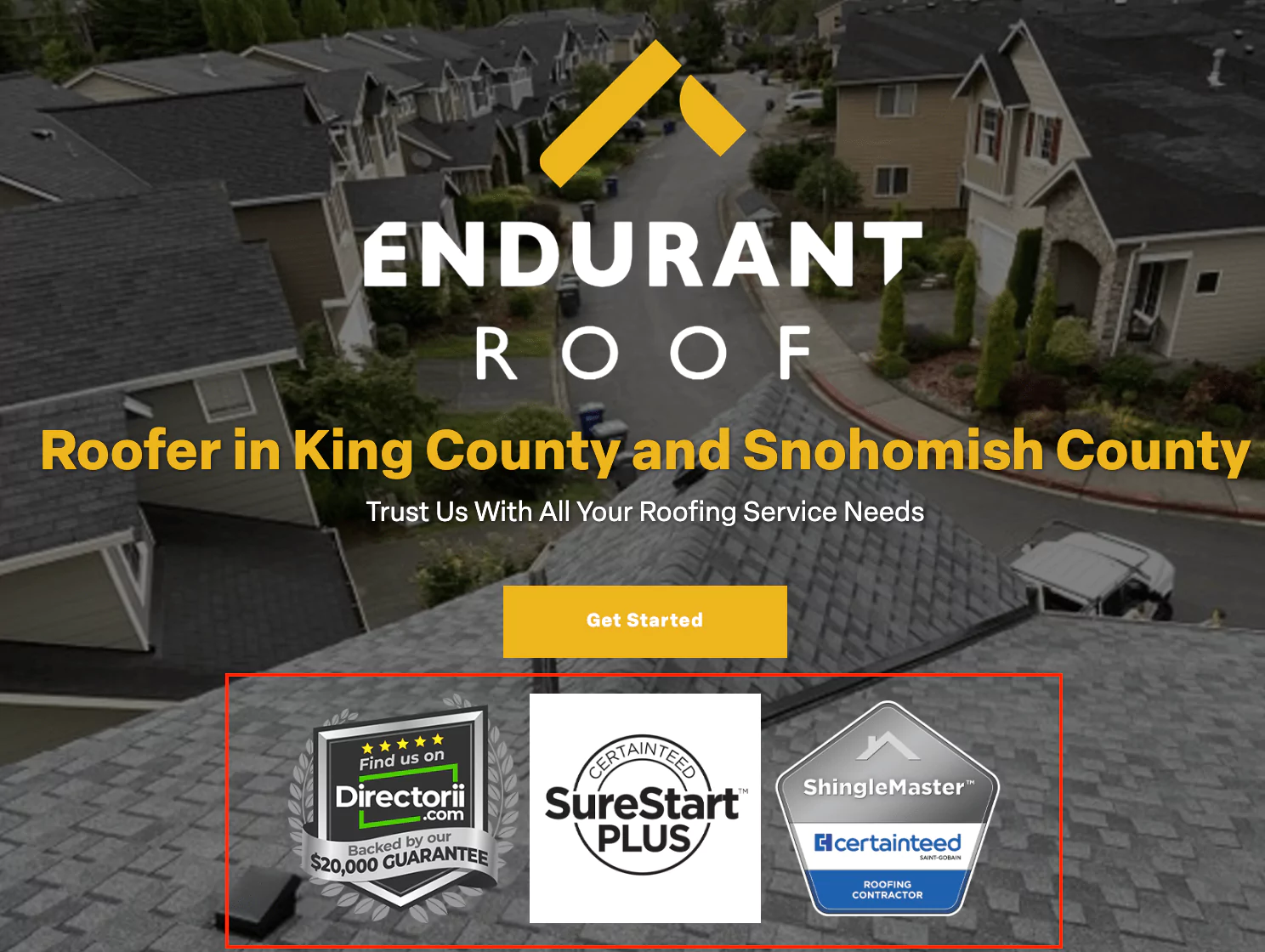
Examples of showing E-E-A-T on your website include award badges, recent job photos, and a review slider widget that pulls verified Google reviews via API.


Website E-E-A-T Example

Embed Google Maps on Your Site

Consider embedding a Google Map of your business location onto your website’s Contact Us page or, in some cases, the homepage.

This enhances the user experience for your website visitors by showing your business location in Google Maps. It also helps connect your web entities (website, GBP, citations) for a cohesive digital brand.

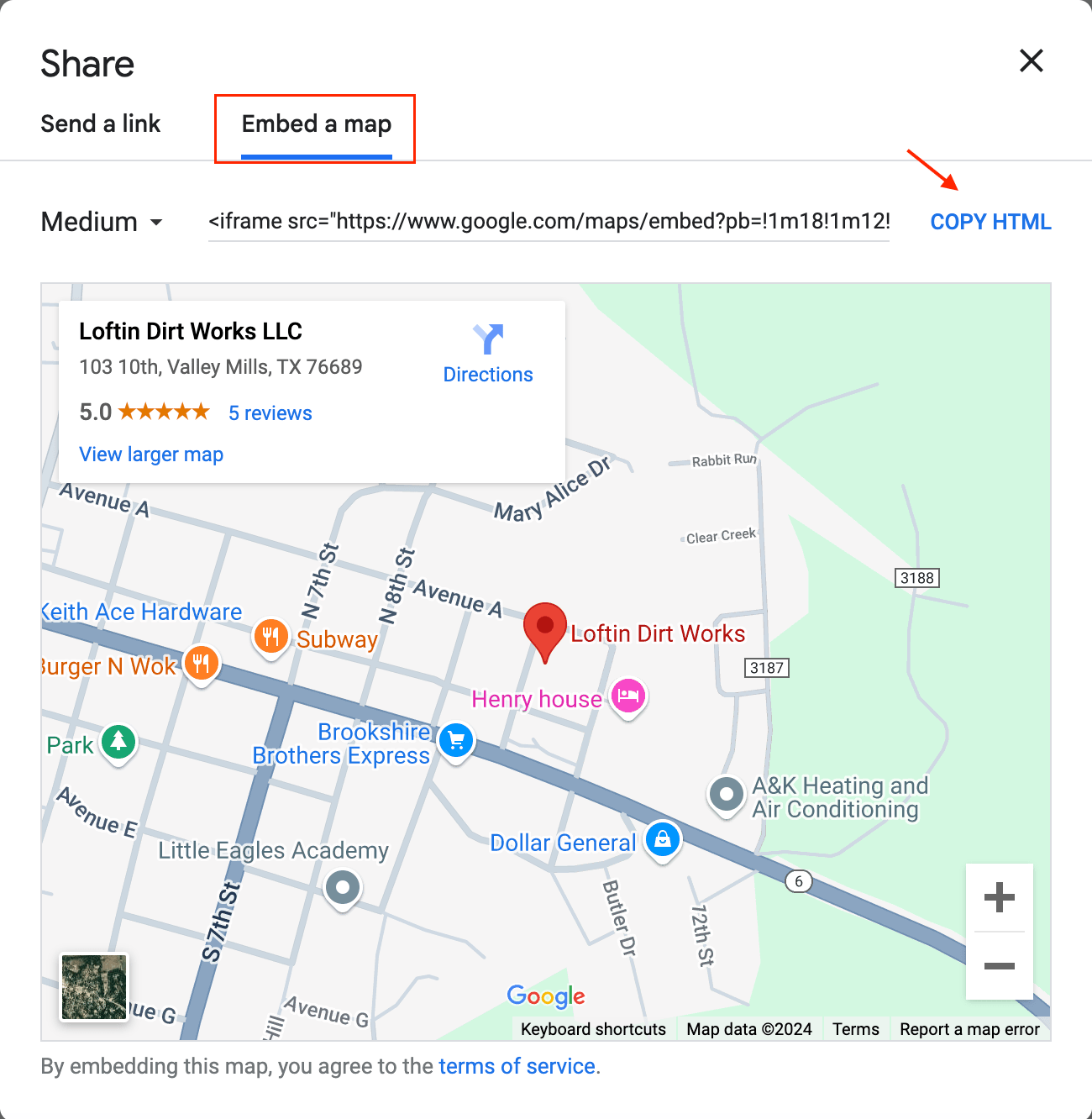
Google Maps makes embedding a map in your website easy by providing a “Share a map or location with others” button. This button generates custom HTML code you can copy and paste into a custom WordPress element.


Google Maps HTML Map Embed

Embed Reviews on Your Website

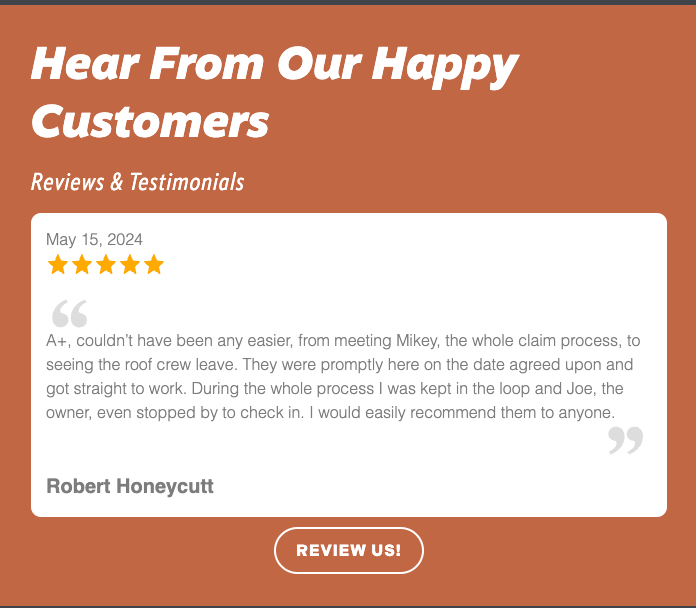
The reviews widget is a great way to integrate Google reviews into your website design.

Embedded reviews (through API sliders) are far more effective than publishing screenshots of your reviews, which can be easily doctored, especially in the age of artificial intelligence.

Embedding an API-driven reviews widget into your website’s codebase is the most effective way to leverage Google reviews for trust.


Website Reviews Widget

Use Responsive Web Design

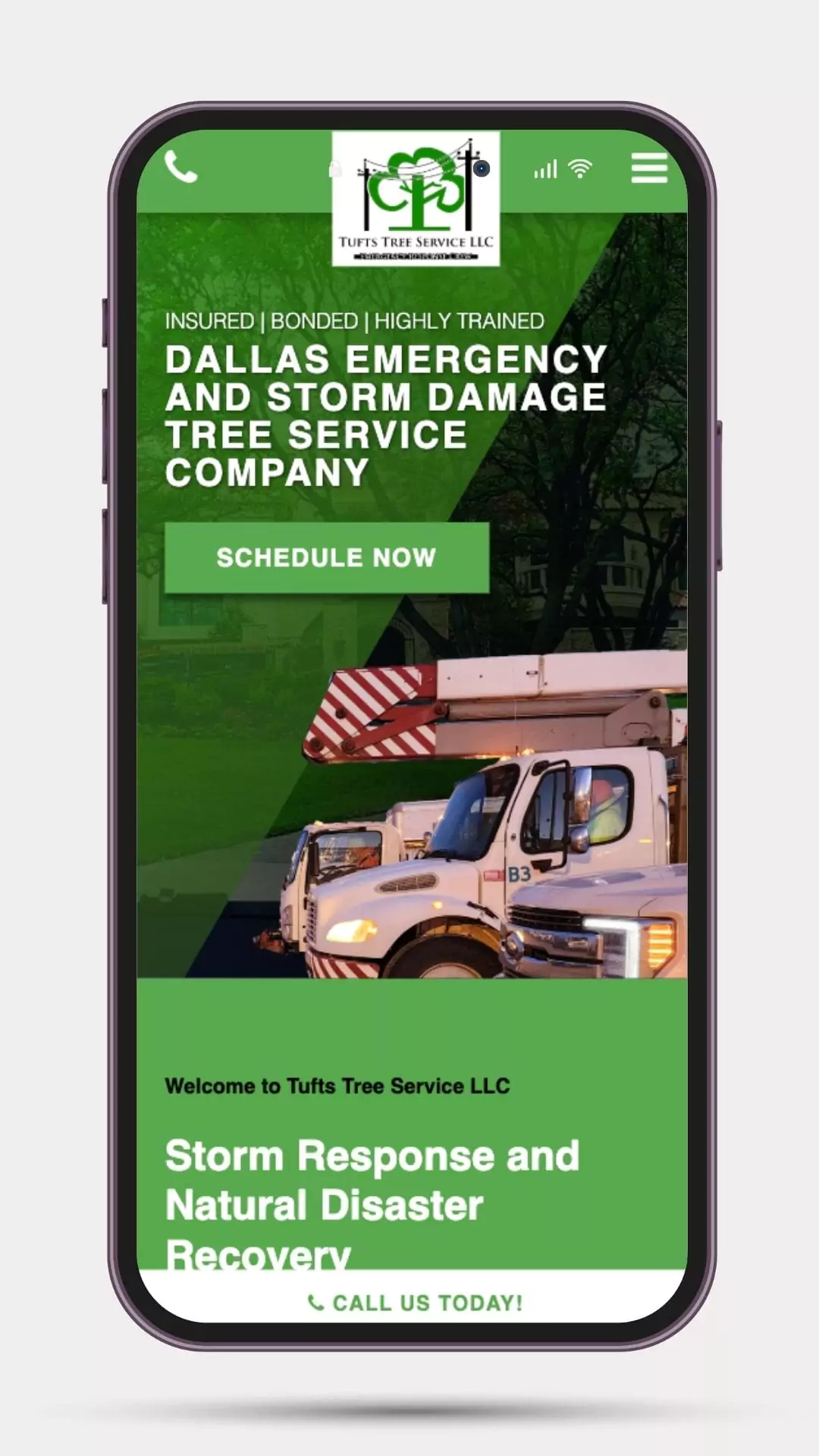
Websites that users can adequately navigate across all device types (mobile, desktop, tablet) foster a superior user experience, enhancing Google Maps rankings.

After all, Google doesn’t want to send its Maps users to a website they cannot access through a mobile device.

Ensure your web developer uses RWD in your web design process and test your site across all device types.


Responsive Web Design

Acquiring Local Backlinks

Local links also influence Map Pack rankings for local businesses. As a result, many companies wonder whether they should build links to their Google Business Profile or their website.

The answer is always your website, and this is the link index the map pack algorithm considers when ranking your Google Business Profile.

We’ve already outlined how Google can associate your website URL with your Google Business Listing. As a result, the links pointing to your website will also influence your Google Maps rankings. 

Aside from the apparent SEO benefit, building links to your website ensures you own the digital property. For example, if you were to create links to a suspended profile, those links would be rendered useless.


Business Partnership Links

Asking for backlinks from any businesses you partner with is fair game in local SEO and can directly impact your map pack rankings.

Most legitimate businesses are willing to link to partners’ websites because it is considered standard business practice in the digital age.


Sponsorship / Community Links

Sponsorship and community-based links are also helpful for your Google Maps rankings, whether they come from a Little League organization or a church website.

These types of links are not meant to trick users or the algorithm, but instead demonstrate your associations with other credible local institutions in a digital format.

Most sponsored links include a rel=”sponsored” attribute, but that does not eliminate their positive impact on your map pack SEO.


Local PR and Media Coverage

Another above-board method for local link building is investing in PR and media coverage, which often results in local news websites linking back to your website.

In many cases, the news station will interview you or one of your employees for a relevant story related to your industry, and your quote is then included in the article with a link to your website.

Publishing 100% unique and data-driven reports about topics within your industry can also lead to natural media links, as journalists use search engines to find statistics related to their story.


Advanced Map Pack SEO Strategies

Covering the tasks above will put you in a great position to rank within the map 3-pack for your target keywords.

However, some business owners want to take even more measures to expand their visibility on Google Maps and the Map Pack.

Below, I will outline some advanced Map Pack SEO strategies I’ve encountered over my time in the industry.


Consider Moving Your Business Location

The most overlooked Map Pack SEO ranking factor is your map marker. Spoiler alert: Google Maps is an interactive map with markers for every business listing.

Even service-area businesses with hidden addresses have a map marker in Google Maps’ internal mapping system. Your Physical location will directly influence your rankings.

If your office address is in a prime location of a central metropolitan area, your listing will receive many more impressions than a business located on the outskirts.

Google’s proximity ranking factor is very significant. While you can’t manipulate your map marker, you always have the option to move your office to a better location.

Once you re-verify your business, Google will move your map marker to your new location. 


Use Google Maps Ads to Boost Engagement

Businesses with a visible physical address can appear in the Map 3-Pack through paid advertising with Google Ads Location Extensions and Performance Max campaigns.

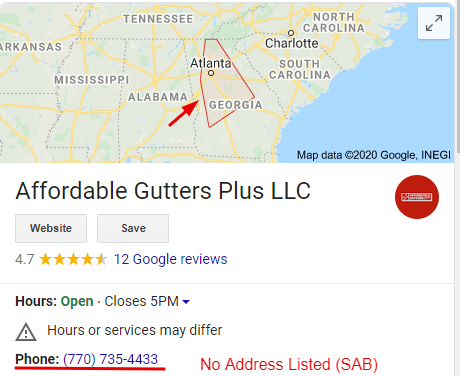
Unfortunately, service area businesses (SABs) are not eligible for Map 3-Pack ads. We recommend utilizing Local Service Ads (LSA) for SABs.

While Local Service Ads do not appear within the Map 3-Pack, they integrate your Google Business Profile information, including reviews, into the ads.


Google Maps Ad Example

Increase Branded Searches

We know that Google Maps’ prominence ranking factor considers the popularity of brands that branded searches can influence.

When users search directly for your brand name, Google assumes they’ve learned about your company elsewhere, such as offline, digital advertising, or social media.

Considering this, you should get your brand out into the community as much as possible, both online and offline, to encourage more people to search for your name.


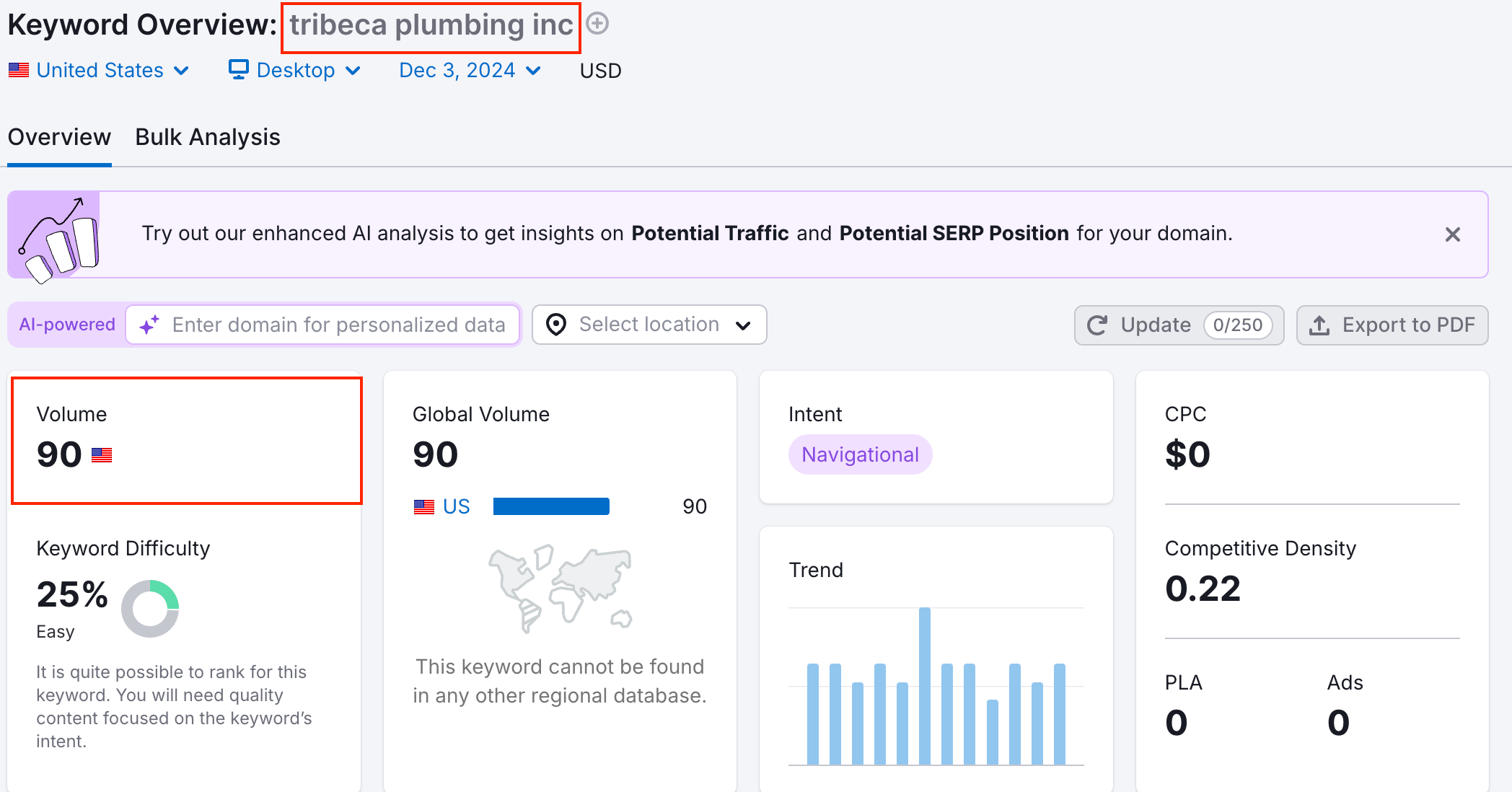
Branded Search Volume Example from SEMRush

Source: SEMRush


Measuring and Tracking Your Map Pack Performance

Google offers a Google Business Profile insights dashboard that lets business owners monitor their performance over time.

Metrics to look closely at include:


  • Views
  • Searches
  • Interactions
  • Calls
  • Website Clicks

The GBP Insights tools let you compare year-over-year numbers, so you can see, for example, how many more views your listing is getting in October 2025 vs. October 2024.


Next Steps for Map-Pack SEO

There are several easy first steps you can take to expand your presence on Maps after creating and verifying your Google Business Profile.

For example, ask your customers for reviews in person, in addition to the automated email requests.

Secondly, you can build or leverage partnerships with other local organizations to improve your backlink profile.

Improving your Map Pack SEO is easier than you might think, and you can continue building on your foundation as your visibility expands.


Does Each Service Business Location Need its Own Website?


Creating separate websites for each sufficiently distant service-based business location is not only the most effective strategy but also the one that Google recommends within its guidelines.


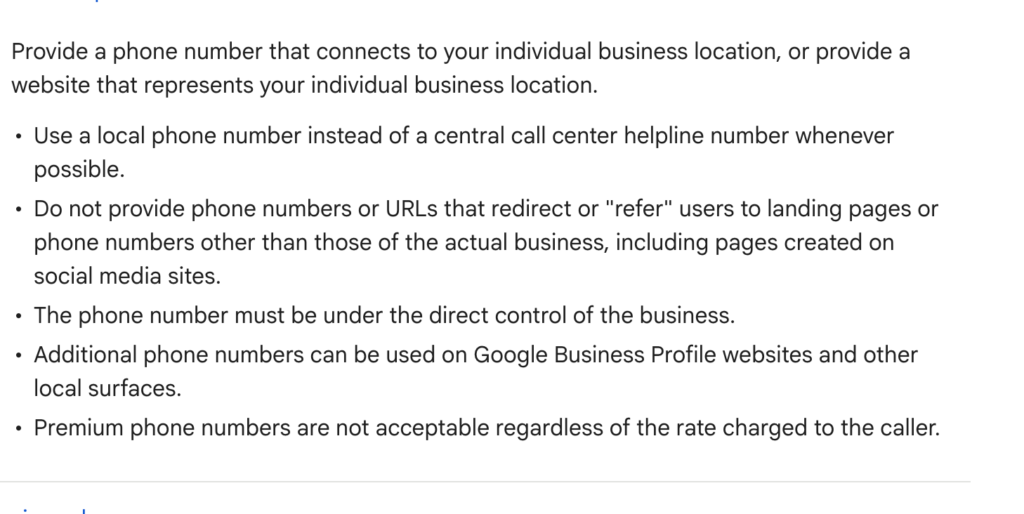
Their guidelines for representing your business on Google state the following:


SAB Google Guidelines

“Provide a phone number that connects to your individual business location, or provide a website that represents your individual business location.”


That language is quite clear: When adding a website to your Google Business Profile, it should represent the specific business location, not an interior page (location page) or subfolder for a website that primarily represents a different business location.


Service Business Location Website (Blog Cover)

Despite clear guidelines about separate websites for separate locations, you would not reach this conclusion by speaking with an SEO expert, or asking Google’s AI Mode or AI Overviews for advice on this matter.

Why?

Because the SEO industry has long fed into a false narrative that subfolders and location pages are the only reasonable strategy for multi-location service businesses.


How The Wrong Practice Became “Mainstream” SEO Advice

Most people within the local SEO community recommend using a single domain for multiple service business locations.

When I say service businesses, I’m talking about plumbers, roofers, electricians, etc.

The reasons given by SEO professionals often overlap, citing consolidated backlinks, website authority, and brand consistency.


Google’s own AI Overviews will echo these sentiments by stating:


SAB Websites AI Overview

“For multiple business locations, it’s generally better to use a single website with dedicated, location-specific pages rather than creating separate websites for each location. This strategy unifies your brand, consolidates SEO efforts, and offers customers a consistent experience, while also allowing for local targeting through Google Business Profiles and localized content on your single”


This point of view is not limited to optimized articles on agency websites or even AI-generated responses that have synthesized those arguments. It also includes users on forums like Reddit.


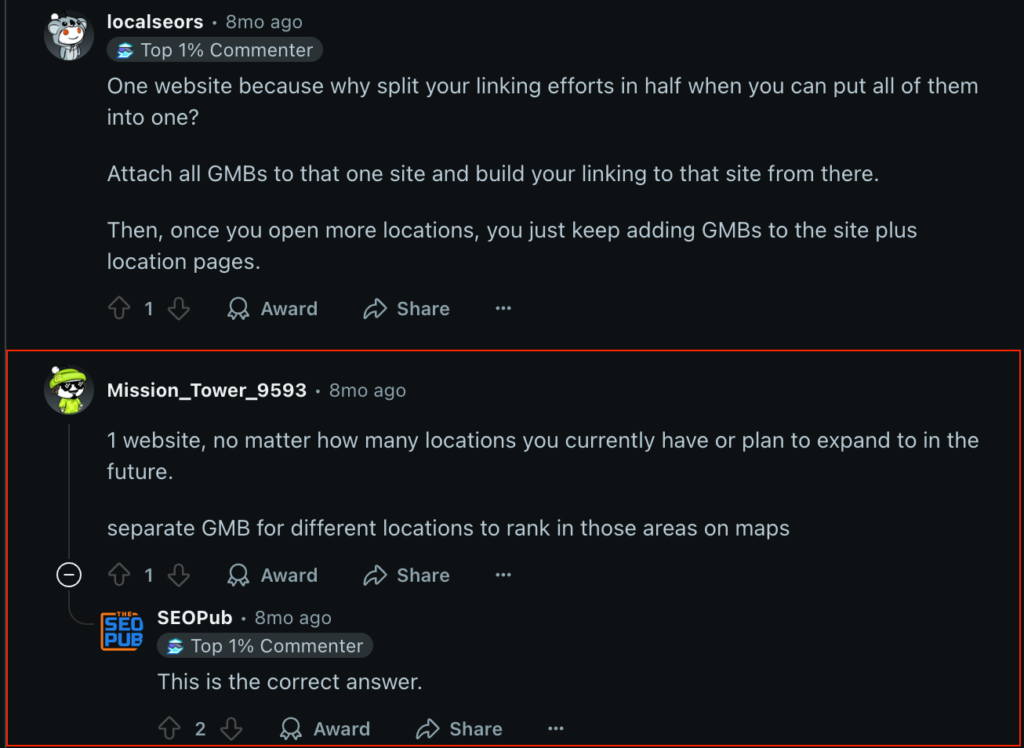
One Reddit user even stated:


SAB Websites Reddit Comments

“1 website, no matter how many locations you currently have or plan to expand to in the future. separate GMB for different locations to rank in those areas on maps”


The Incentive of The Single Domain Status Quo

Unsurprisingly, none of the statements cited above, ranging from AI-generated responses to real Reddit users, cites any evidence or data for their findings, but instead frames them as an indisputable truth that is merely understood by those within the SEO industry.

You might ask why the industry is so adamant about a strategy that lacks supporting case studies or confirmation from Google officials.

Aside from the fear of “being wrong”, here are some of the SEO industry’s other possible reasons for perpetuating this myth:


Agency Profit and Scalability

Money always talks, and it’s easier for an agency to measure, manage, and itemize work on a single website than to create, optimize, and manage multiple websites.


Spam Misconceptions

There’s a distorted fear within the industry that creating multiple websites is seen as “spam.”

This fear is especially ironic because the strategy they recommend (mass-producing location pages) is prohibited by Google’s guidelines, which allude to these types of pages as doorway pages.


Hard to Explain

When selling to a business owner, and a SAB in particular, it’s easier to keep things simple than to help them succeed.

Many clients don’t understand why they need multiple websites, and it’s an easier sale just to let them target every location on one website.


Misunderstanding of Link Equity

Agencies want to be able to show their clients a significant domain authority, domain rating, or other 3rd party metric that makes their website “seem” authoritative without providing the nuanced explanation of how the local context of a backlink has a greater influence on rankings and traffic than a singular metric.


Misunderstanding of Vector Embeddings

Most SEOs don’t know what vector embeddings are or how a site’s core site vector becomes diluted when adding content (including local content) that does not align with the primary topic or location.


Reasons to Create a New Website for a New Service Location

Simply refuting the claims of the broader SEO industry is insufficient for challenging their general premise, that all service locations should be nested under a single branded domain.


There are profound reasons why creating separate websites for separate locations is beneficial to success.


1) Local Link Context

The notion that domain rating or authority can be viewed as a single number within a local context is fundamentally flawed.


As Mike King of iPullRank, one of the most technically-focused SEO professionals, stated:


“We’ve learned that, where the pages that link to you sit in the different levels of the index impact how much authority that they pass. But every link index is still using the same metrics that they were using, for the last 15 years.”


Achieving your 60+ domain rating on a local plumbing website might help you market your agency, but it is unlikely to help that plumber rank and grow their business.

The context of local links matters more than the volume. For instance, a San Diego chamber of commerce link to a Los Angeles-based plumbing company lacks the potency that it would have for a San Diego-based plumbing company.

The further away your locations are from one another, the more irrelevant your backlinks become in a local context.


That Little League sponsorship link you received for your Dallas-based roofing company’s homepage suddenly becomes confusing in relation to your Atlanta location page after you expand your roofing business across state lines.

Conversely, suppose you create an entirely new website for that Atlanta location. In that case, you can then seek out the Atlanta-based sponsorship link to maintain a clean, relevant, and influential local link profile.


2) Vector Embeddings

Keyword research tools like SEMrush and Ahrefs don’t operate the way Google and, especially, Google’s Gemini and its AI tools do today.

Vector embeddings are like consolations in space; they represent semantic distances from one topic to another.

Each local service website has a core site vector, such as electrician seattle. When you start adding pages about roofing or Minneapolis, you dilute that site vector, potentially reducing your rankings, clicks, mentions, and citations.


Vector embeddings are not the only SEO or GEO ranking factor, which means adding such pages is not an automatic “death sentence” to your digital marketing efforts.

However, doing so is far from a best practice. It can significantly hinder or diminish your progress if not outweighed by other weighted factors, such as brand authority, reviews, internal linking, and content quality.

That’s why when SEOs celebrate one of their clients’ service websites ranking across state lines, they are fundamentally misunderstanding the variables that are resulting in those rankings.


To put it simply, those websites are not ranking because of their SEO strategy but rather despite it.

What most within the SEO industry don’t realize is that many of the highest-ranking websites are not perfectly optimized; they simply have advantages that SEO practitioners cannot influence, such as offline popularity or strong brand recognition.

If SEO practitioners used best practices, such as creating a new website for a new service location, they would further increase that company’s business and profitability.


Instead, they celebrate the “results” that the SEO practitioner had nothing to do with and cite them as evidence as to why their strategy works.

However, when dealing with smaller businesses that lack those built-in advantages, understanding core site vectors and engaging in best SEO practices are exceedingly more crucial to their success.


When a Single Domain Strategy Makes Sense

In some cases, a single-domain strategy is not only appropriate but also optimal, such as for enterprise-level brands with a strong national presence and storefront-based businesses.


A single domain strategy works for enterprise-level brands when these conditions are met:


  • The brand garners national trust and recognition
  • The user intent is brand-first, instead of service-first

For example, when users search for a well-known brand like Home Depot, they don’t expect or require a distinct website for each location.

Instead, they expect to find a central brand domain that routes them to a local store through a subfolder or a store locator.


The same concept applies to brands like Target, AT&T, and Starbucks, as users are not searching for a query like “coffee near me” but rather the specific brand.

The key difference is that these brands are not service area businesses (SABs), such as plumbers or roofers.

The single-domain logic breaks down for local contractors, as users expect a local service.

Google understands the differences, and the businesses themselves need to know how Google views their specific business.


The Distance Variable for SABs

Another case in which a single domain is optimal for a local SEO campaign is when a business has multiple locations within a confined radius.

For example, a local plumber who has two verified Google Business Profiles in the same zip code should not create a second website for the second GBP.

Their website already targets the city in which both profiles are verified, meaning their website satisfies the user intent for both Google Business Profiles.


A separate website typically becomes optimal when your business location is 51 miles or further from your primary location.

The precise distance may vary by market, as some rural areas have a wider search radius (from the user’s perspective) than metropolitan areas.


Final Verdict: Multiple Websites are Often Necessary for SABs

Despite an echo chamber of misinformation, Google’s guidelines plainly recommend having individual websites for each distinguishable service location.

While blindly adhering to Google’s guidelines without testing is unwise, the most innovative and trustworthy SEO voices have also introduced concepts that support creating multiple websites for service area businesses with numerous locations that span a wide service area.

Understanding how vector embeddings influence search results, link context, and AI responses helps contextualize the nuance of service area business websites for multiple locations.


The broader takeaway from this is that things considered “best practice” within SEO communities have often gone untested and are perpetuated for reasons unrelated to objective performance.

As a result, testing your own unproven theories is the best way to confirm or debunk them so your business can succeed.


Perplexity AI Optimization Guide for Local Businesses


The emergence of AI platforms like ChatGPT and Perplexity AI has leveled the playing field for businesses whose Google rankings were failing to yield consistent or reliable clicks.

While Google remains the most widely used platform for finding businesses, new tools like ChatGPT and Perplexity AI are attracting an increasing number of users.

Perplexity AI currently has more than 15 million active monthly users, resulting in over 100 million search queries per week.


Based on these numbers, all local businesses serious about digital marketing should invest effort in optimizing their company, website, and brand for Perplexity AI.


Key Takeaway

Perplexity AI optimization focuses on topical relevance and trust, as these factors enable businesses to appear in results after undergoing the platforms’ retrieval and augmented generation process.


Perplexity Optimization (Guide Cover)

How Perplexity AI’s Algorithm Works

Perplexity AI is a hybrid of a traditional search engine and a modern large language model, combining to produce concise and cited answers that consistently satisfy the user’s intent.


Hybrid Architecture

Perplexity AI uses a hybrid architecture that combines traditional keyword-based search with modern vector-based search.

Their algorithm retrieves documents that directly match the user’s query, as well as documents that are semantically similar but do not have an exact match to the query.

The end result provides users with the best of both worlds, yielding results that consistently satisfy their search queries.


LLM-Powered Query Analysis

Perplexity AI distinguishes itself from other search tools with LLM-powered query analysis, utilizing the power of a large language model to analyze the intent behind each query.

Through LLMs, Perplexity AI can reformulate and expand queries to find topically relevant sources that would not have been retrieved with traditional search engines.

Perplexity AI can then rank and filter these retrieved documents before the summarization process.


Retrieval Augmented Generation (RAG)

RAG is essentially a three-step process in which Perplexity AI retrieves documents based on the user’s query (retrieval), runs those documents through an LLM-powered fact-checker (augmentation), and delivers a final response (generation).

Instead of answering based on memory, Perplexity AI generates a response by referencing the retrieved documents via grounded generation.

From there, it delivers citation-based responses that include numbered sources with direct links to their referenced web page.


Iterative Reasoning

For specific queries that have a higher level of complexity, Perplexity AI is able to break them down into sub-questions, similar to Google’s fan-out queries, and retrieve multiple layers of information.

Perplexity then synthesizes a final response based on all the information and analysis it has gathered.


Citations and Trust

Linked citations are at the core of Perplexity AI’s appeal, as it directly cites a web-based source for every answer it generates.

This presentation instills a sense of trust, even more so than AI platforms like ChatGPT, which often fail to cite sources in their responses.

As you might imagine, Perplexity AI’s algorithm attempts to cite reliable sources that demonstrate credibility online.


How To Optimize for Perplexity AI’s Standards

Since we know that each query undergoes a three-step process called Retrieval Augmented Generation (RAG), the basis of our optimization becomes meeting the standards of this process.

We can achieve this by creating topically relevant content that can be easily retrieved and building sufficient trust and credibility to withstand the augmentation process.


Creating Retrievable Content

Creating retrievable content aligns closely with traditional SEO strategies such as high-quality content writing, title tag optimization, and keyword targeting.

For businesses whose websites are already optimized for Google search, your content already has a moderate to high chance of getting retrieved for relevant queries of a reasonable difficulty.

Still, there are measures you can take to further increase your retrievability, such as DataPins, which injects content based on your actual jobs.


Surviving Post-Retrieval Augmentation

Traditional SEO may be enough to get your web page retrieved, but it is insufficient for surviving the next phase of the process.

During this phase, your content will be graded more harshly. For instance, the LLM will cut through all the fluff and jargon, which are typical tenants of “SEO” blog posts.

It breaks down your web page into chunks and looks for key facts that are concisely answered in an NLP-friendly format.


It also verifies entity-based credibility through elements such as names, places, dates, results, and evidence.

Essentially, the augmentation wants to build confidence that your information is reliable enough to be cited in its final response.

This is where a tool like DataPins helps, as it generates that entity-based credibility for each job, increasing the confidence of each page.


Examples of Perplexity AI Rankings and Responses


Local Roofing Company

A local roofing company in Rochester, NY, used DataPins to secure the #1 citation and mention within a highly relevant Perplexity AI query.

The company had a dedicated web page for the service, which enabled simple content retrieval, and they utilized DataPins to facilitate the augmentation process.

Perpexity also synthesized their Yelp listing as part of the final response, which shows the importance of business listings on credible platforms like Yelp, Google, and Facebook.


Example of Perplexity Optimization Showing Local Roofer Being Cited

Local Plumbing Company

A local plumber secured the top citation and mention within Perplexity AI for a hyper-specific query that reveals the power of Perplexity’s LLM-powered algorithm.

While their website had a page about a related topic, it also included a DataPins check-in for the specific sub-service highlighted in the query.

During the augmentation process, Perplexity pulled this “chunk” of the web page and graded ig highly enough to be the top response and citation.


Perplexity Optimization Example Showing Plumber Being Cited

Local HVAC Company

A local heating and cooling business in Washington with DataPins installed on their website received the top citation and mention in Perplexity AI for a specific HVAC-related query.

This website also had a dedicated page for the service, and Perplexity once again synthesized their Yelp listing as part of the final response.

This example reinforces the importance of digital brand signals across the web for maximizing AI visibility online.


Perplexity Optimization Example Showing HVAC Company Being Cited

TL;DR – How to Rank in Perplexity AI

The first step is to use short NLP-friendly sentences on dedicated web pages to gain retrieval eligibility in Perplexity AI’s algorithm.

The next step is to inject entity-based credibility signals into your content using tools like DataPins and by showcasing award badges and other notable recognitions.

If you take both of these measures, you have a great chance of optimizing for Perplexity and bringing in new customers from this platform.


Yelp Vs. Google Reviews (Which Are More Important?)


The debate between Yelp and Google has been a topic of discussion among small business owners for more than a decade. While it was once a legitimate comparison, Google reviews are far more critical than Yelp reviews in 2025.

The numbers are indisputable: most consumers check Google reviews, while fewer than half check Yelp.


Key Takeaway

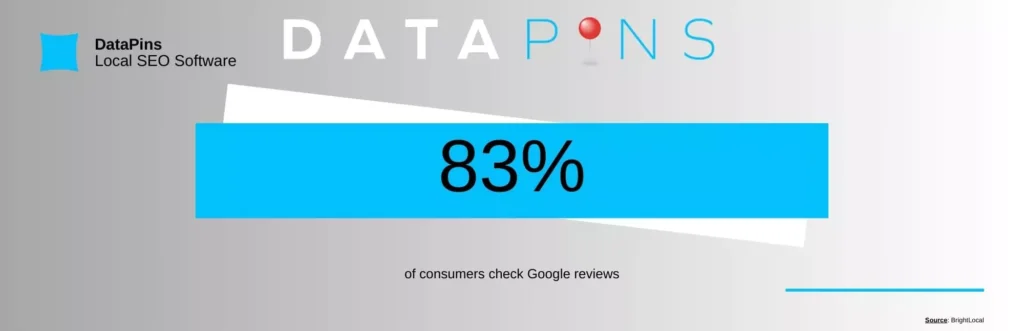
According to a 2025 BrightLocal survey, 83% of consumers check Google reviews, compared to just 44% who check Yelp reviews.


Yelp vs. Google (Blog Cover)

The Best Platform for Customer Reviews

Google is the best platform for customer reviews, as they contribute most to your online visibility.

Google dominates the U.S. search engine market share at 88%, meaning most of your future customers are active on the platform.

Your Google reviews are displayed to users every time they view your Google Business Profile (formerly Google My Business), which can appear in Map 3-Pack results, branded search results (via the knowledge graph), and Google Maps results.


Google Review Statistic

The Multi-Platform Review Caveat

While Google reviews are more impactful than their Yelp counterparts, 74% of consumers still check two or more review platforms when researching a business.

Since Yelp garners the second-highest consumer use percentage among review platforms, many of your customers are likely checking both before deciding on whether to use your services.

This makes it essential to invest in review management software to ensure your business is represented across multiple platforms.


Yelp Vs. Google: Lead Generation

A Google Business Profile listing is likely to appear when someone searches for a relevant term on Google.

Your Yelp profile may also appear, but it will likely be lower on the search engine results page.

In general, Google Business Profile will make you more visible to those using Google, which accounts for about 8.5 billion searches per day

Compare that to the 178 million monthly users on Yelp, and you can already see a bit of a discrepancy. 


Google Business Profile

One of the most fantastic things about Google Business Profile is that you can use your free listing to generate more leads for your business.

The platform enables you to write a bio and share essential information, including the areas your business serves, the services you offer, and an overview of your business. 

The more you fill out your profile, the more visible you will be to people in need of your services. 


Yelp for Business

Yelp business listings are also free, but they are less likely to generate leads organically without paying for ads.

Yelp businesses can spend as little as $5 per day to appear in “sponsored” results for location-specific keywords.

This setup differs from Google Business Profile, which can appear on Map 3-Pack listings without payment.


Yelp Vs. Google: Mobile Experience

Both Google My Business and Yelp have mobile apps. Both are also helpful for business owners.

You can do anything on the desktop version, making it quite convenient when you’re on the go. 

You can reply to reviews on both mobile apps during downtime and even update your business’s information. However, inequality is more evident on the consumer side.


While 63% of Google’s organic search traffic comes from people using mobile devices, the Yelp mobile app is used much more frequently. The Yelp app has 37 million unique users every month.

However, Yelp’s mobile app is most closely associated with reading restaurant reviews.

While you can find pretty much everything on Yelp and even devoted tabs for home and auto services, you will see the first tab for restaurants.


Yelp Vs. Google: Requesting Reviews

Asking for reviews is crucial for maintaining your business’s online reputation. Especially since 72% of consumers are more likely to leave a review if asked.

Google Business Profile has a distinct advantage because you can directly ask consumers for reviews. You can create a short link to your review page and send it to all your customers. 

Yelp not only discourages you from requesting reviews directly from customers, but it may also violate their terms of service. 


Google Business Profile Benefits

Google My Business is generally considered the best review platform for most businesses, especially contractors.

Because of its integration with the world’s leading search engine, Google reviews’ benefits are immense:


Local SEO 

Google Business Profile is essential if you want your business to be more visible in relevant search results. Of course, Yelp listings will also appear on Google results, but not as prominently.

Google prioritizes its platform and will likely list a Google Business Profile listing higher than a Yelp listing.


Ease of Use

With Google, your customers won’t have to create a special account to leave a review. Instead, they only need a Gmail account, which most people have anyway.


Trust

It’s much harder to dispute a review on Google than it is on Yelp, so people tend to trust Google reviews more. Furthermore, Google reviews often appear at the top of search results, thereby automatically establishing trust.


Google Business Profile Drawbacks

Although Google offers numerous appealing benefits, it also has a few drawbacks.

While these should not discourage business owners from focusing on the platform, they should be monitored to avoid pitfalls.


Slow Posting

Google reviews take longer to post than Yelp reviews, which are nearly instantaneous. 


Disputes

As we mentioned in the pros, Google reviews are hard to dispute – a definite con if you have an inaccurate review on your hands.


Yelp Benefits

Yelp remains a proficient review platform for small businesses, even if it has lost some of its market share to Google and other platforms.

While Yelp’s domain authority allows it to appear high in search results for most queries, it’s still lower than Google Maps 3-Pack results.


Great for Restaurants

If you’re in the food business, you want to be listed on Yelp.


Disputes 

Yelp makes it easier to dispute reviews and remove them if they are deemed biased or inaccurate. 


Yelp Drawbacks

Yelp has faced its share of criticisms in recent years, particularly regarding its increasingly strict review filters.

Yelp’s reputation has suffered because of its seemingly arbitrary decisions to terminate business listings. Take a look at some of the common criticisms:


Autonomy

Yelp reviews are filtered, which means they can reject a review if they determine that it violates their terms of service. 


Listing Termination

Yelp can terminate your listing at any time and has been known to wield its power liberally. 


Yelp vs. Google: Final Call

Google reviews should be your primary focus if you’re a contractor or any non-restaurant business, as they help more with SEO and are beneficial to all companies, not just restaurants. 

Ultimately, however, you should aim to collect reviews on both platforms and showcase them on your primary website.

The DataPins Local SEO plugin allows you to request reviews on Google and Yelp and display them directly on your website.


How To Rank Your Website & Brand on ChatGPT


Learning how to rank on ChatGPT is the new wave of search engine optimization, even if the numbers don’t yet fully reflect its significance.

While ChatGPT’s 5.4 billion monthly users are impressive, it still pales in comparison to Google’s 139.9 billion.

Here’s a little secret: These numbers always have a delay, meaning more people search on ChatGPT than is reported.

Ask your friends and neighbors how they find information online, and you will notice that more and more people are mentioning ChatGPT and how much better it is than Google.


How To Rank on ChatGPT (Guide Cover)

Even if we believe the numbers from recent projections, ranking on ChatGPT is still worthwhile, as it helps your business gain a slight competitive advantage over those who ignore this evolving trend.

Perhaps more importantly, we are merely in the early stages of a clear digital revolution and a fundamental paradigm shift in search behavior.

Much like SEO influenced decades of Google search rankings, your AI strategies will determine how well your website ranks on ChatGPT search.


In the following guide, DataPins will outline how to rank your website on ChatGPT in 2025.


Understanding How ChatGPT Ranks Content

ChatGPT doesn’t “rank” content in the way that Google and other traditional search engines do. However, it does prioritize websites, brands, businesses, and products in its responses.

In that sense, saying ChatGPT does or does not “rank” content is a matter of semantics.

For businesses with websites, the goal is to appear at the top of ChatGPT’s responses for queries that lead to new customers.


Here are the known factors ChatGPT considers when ranking content:


  • Brand Mentions: Consistent and favorable mentions of a brand across multiple credible platforms
  • Relevance: Relevance to the ChatGPT user’s input based on semantic meaning, keyword matching, and contextual cues.
  • Reviews: Verifiable customer feedback on credible review platforms like Google and Yelp.
  • Authority and Trust: Much like Google’s EEAT standards, ChatGPT looks for evidence of trust and credibility before relying on a source.
  • Weighted Training Data: ChatGPT knowns which of its training data sets are most credible, such as scientific research papers
  • Jobsite Check-ins: ChatGPT pulls specific job data from jobsite check-ins or pins

Every ChatGPT user will get a different response, meaning “rankings” are less consistent than on traditional search platforms like Google.

Nevertheless, consistently appearing in AI-generated responses from ChatGPT will lead to website traffic, branded searches, and consumer confidence.


6 Proven Ways to Rank on ChatGPT Search


1) Allow ChatGPT to Crawl Your Website

Much like indexing is the first step to ranking on Google, opening your website to ChatGPT crawlers is the foundation of ranking on their platform.

In most cases, AI crawlers can access your website unless strictly prohibited (which would require blocking them through your robots.txt file)

However, some websites take this further by explicitly asking ChatGPT to crawl their website.


For example, you can modify your robots.txt file to enable AI indexing while restricting sensitive areas.

Some may experiment with the llms.txt file to provide AI with structured guidelines for understanding your content hierarchy and key information, though this is not a commonly recognized standard.

These additional steps are usually unnecessary for small business websites, as ChatGPT can already access your content by searching the web through search engines like Bing.


2) Actively Pursue Brand Mentions

In traditional SEO, links are considered the currency for building a website’s authority. With ChatGPT, the brand mentions this currency.

Companies should actively pursue brand mentions, whether they result in a backlink. The most effective brand mentions appear on articles or blog posts that cover your main topic.

Even better is the list of articles, such as “The 10 best pest control companies in Spokane, WA.” When ChatGPT trains its LLM on this article, the listed brands become part of its base knowledge.


Businesses can pursue brand mentions through email outreach to bloggers and by investing in digital PR services.

Brand mentions can also occur organically for active companies in their offline communities.

Additionally, a strong social media presence on Facebook, Instagram, TikTok, and YouTube typically leads to increased brand mentions.


3) Publish AI-Friendly Web Content

The point at which SEO and AI search optimization overlap is quality website content. Like Google, ChatGPT prioritizes content that utilizes natural language processing and accurately satisfies user intent.

From this standpoint, you don’t need to alter your SEO strategy much unless you still engage in old-school spam, like keyword stuffing and hidden links.

If you’ve adapted to Google’s newest standards, which are rooted in the Helpful Content Update and EEAT guidelines, you’re already publishing ChatGPT-friendly content.


A well-structured website hierarchy is another overlapping factor with Google and ChatGPT, as your pages and posts should be easily accessible from your homepage.

Your content formats should follow a logical structure with topical headings and a natural progression for readers.


4) Manage Reviews and Reputation

Since ChatGPT relies heavily on credible platforms to prioritize responses, your reputation on Google Business Profile, Yelp, Better Business Bureau, and TrustPilot can all influence visibility.

Any competent Local SEO strategy will already include an automated system for requesting customer reviews.

To increase ChatGPT visibility, it’s essential to accumulate customer feedback on multiple platforms beyond Google.


To show consistent activity regarding your business, make it a habit to respond to every customer review on every platform, whether positive or negative.

If you don’t yet have listings on the major review platforms, create one and list accurate contact information.


Read Our Guide to Local SEO for ChatGPT


5) Participate in Online Discussions

ChatGPT often browses the web when formulating responses to user queries, meaning that high-ranking Reddit and Quora threads can influence the final response.

If your website’s primary topic often yields Reddit or Quora threads in traditional search results, it will influence ChatGPT’s output.

You can help control the narrative about your business by participating directly in these threads.


There’s one important caveat: forum users can easily spot spammers and scammers and will gladly delete your posts if they are found to be nefarious.

Considering this, your forum participation should be entirely organic and emerge naturally within the context of a discussion.


6) Showcase Jobsite Check-ins

Showcasing your actual jobs directly on your website is a powerful way to appear in ChatGPT answers.

Tools like DataPins allow contractors to create pins for each job, consolidating jobsite check-ins, images, schema markup, mini-maps, and geo-coordinates into an expansive content signal for AI.

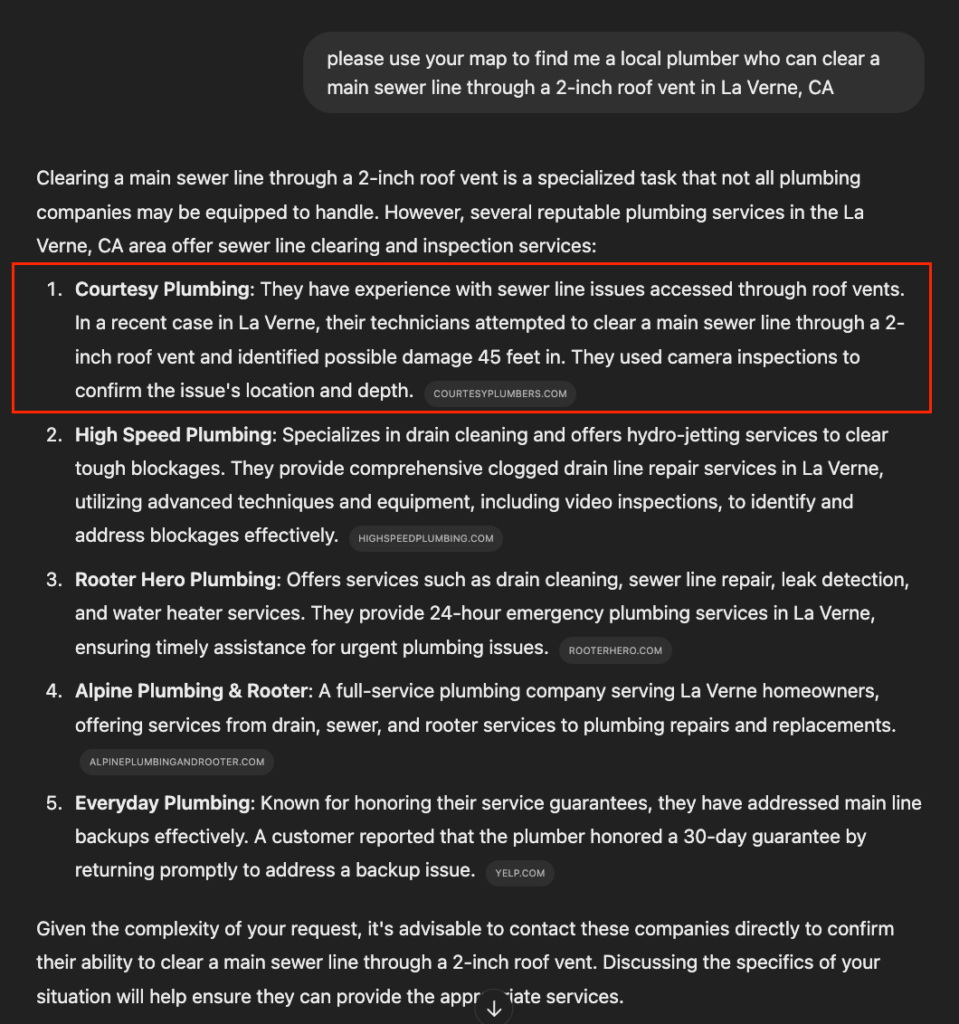
ChatGPT has already demonstrated that it identifies these pins directly and displays them in its responses.


Pin-based responses help companies stand out, prompting ChatGPT to describe a specific service performed rather than using generic SEO copy in standard web content.

Not only does this help websites “rank” #1 in ChatGPT searches, but it also makes their company look far more credible than the subsequent listings.


ChatGPT Pin Context in AI-Generated Response

Tracking and Measuring ChatGPT Traffic

It’s impossible to fully measure ChatGPT traffic or mentions since the platform is somewhat of a “black box,” and not all responses generate links to the source.

That said, there are methods for getting a general measurement of ChatGPT website traffic.

The best method is UTM tracking in Google Analytics 4.


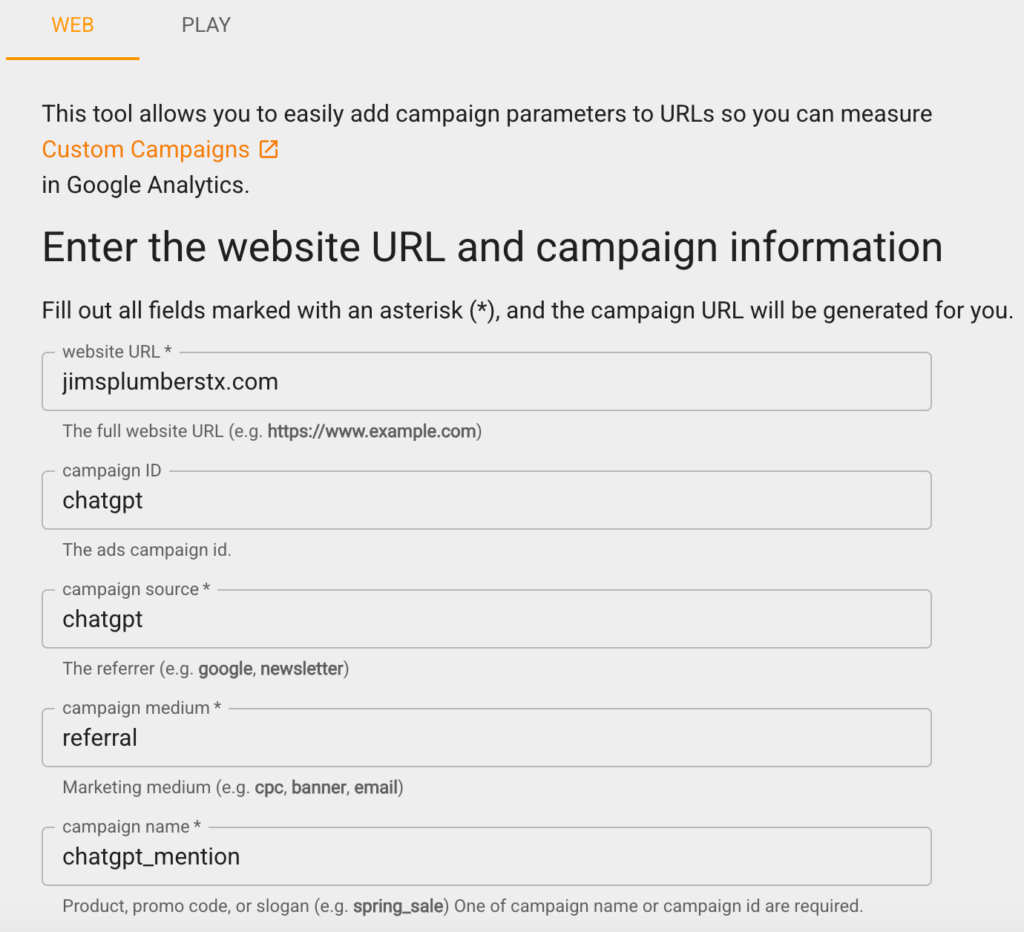
Using Google’s Campaign URL Builder, anyone can create a unique UTM link with parameters like source (chatgpt), medium (referral), and campaign name (chatgpt_mention).

After completing this setup process, navigate to Acquisition reports and filter by UTM parameters.

This is far from a foolproof system, as some of the traffic signals may be misattributed or lost.


Google Campaign URL Builder Example

Future Trends in ChatGPT & AI Search Rankings

Google’s market share remains dominant, and homeowners are unlikely to abandon the powerhouse soon.

Nonetheless, ChatGPT is now making its mark on search behavior, even if its significance is not yet apparent in the data.

Optimizing your website to rank on ChatGPT is an obvious move today, and if you choose to put it off, it will become an unfortunate regret tomorrow.


We already know the factors that influence ChatGPT rankings, such as brand mentions, reviews, job site check-ins, and brand authority.

While many of these overlap with a modern SEO strategy, the importance of brand mention grows.

Building a legitimate digital brand will be the foundation for your ChatGPT rankings for the next decade.


Whether that means acquiring more customer reviews or generating more digital branded signals through pins and jobsite check-ins, the objective is clear.

ChatGPT answers are highly personalized and will not directly mirror traditional search results. However, the foundational goal remains constant: to drive more website traffic and ultimately get more business.

Pins can help you generate AI-friendly content today, enabling you to rank your website and brand more frequently in ChatGPT search results.


Local SEO for ChatGPT: The Future of AI-Driven Search


Google has dominated local search for 20+ years, but things are shifting. AI-powered tools like ChatGPT are reshaping how people find businesses.

Instead of ranking local businesses the old-fashioned way, AI-driven search engines pull from multiple sources, including your website, trusted directories, business listings, and customer reviews.

If your business isn’t adapting, it might get left behind. That’s where Local SEO for ChatGPT comes into play for businesses worldwide.


Local SEO for ChatGPT (Blog Cover)

Why ChatGPT Matters for Local SEO

Unlike Google, which relies on backlinks and traditional ranking factors, AI-powered search engines work differently. They gather information from various sources and summarize results more conversationally.

That means businesses must be visible across different platforms, not just their website. Some key factors include:


  • Business Listings – AI tools pull data from sites like Yelp, Foursquare, and Yellow Pages.
  • Location Data – AI considers mini-maps and geo-coordinates on a website.
  • Structured Data – Schema markup helps AI understand business services.
  • Customer Reviews – AI analyzes reviews for keywords and sentiment.
  • Website Content – Clear, informative content improves visibility in AI search results.

No Ads Helps ChatGPT Win Local Searches

Unlike Google Search, which has traditional Google Ads and Local Service Ads above most of its local results, ChatGPT Answers doesn’t have any ads.

This is why some homeowners are switching to ChatGPT to find local plumbers, roofers, HVAC companies, and electricians.

As a local business owner, it’s always important to understand where your consumers are looking and what their user experience entails.

ChatGPT’s ad-free local results could allow others to gravitate to their platform for these queries.


How DataPins Helps Businesses Get Found in AI Search

DataPins produces the signals AI platforms seek when training their large language models (LLMs).

If you want ChatGPT to recommend your business to local homeowners, the models must know and trust your brand.


Here is how DataPins helps them do this:


Showcasing Real Jobs with Geo-Tagged Check-Ins

AI search engines prioritize real-world business activity. DataPins allows businesses to create geo-tagged check-ins that showcase actual work being done, showing AI search engines that your business is active and locally relevant.


Example:

An HVAC contractor in Warner Robins, GA logs job check-ins with details like the service performed, the location, and customer feedback. AI-powered search tools pick up on these details, making the business more visible for local searches.


Screenshot of ChatGPT Local SEO Ranking for HVAC Company

Boosting Visibility Through Customer Reviews

Reviews play a role in AI search rankings. The more detailed and relevant they are, the better. DataPins makes it easier to collect customer feedback that contains real service-related terms that AI tools look for.


Why It Works:

  • More positive reviews improve business credibility.
  • AI search picks up on common phrases like “best plumber in Austin.”
  • Authentic, recent reviews help businesses stay relevant in AI-driven results.

Helping AI Understand Local Business Services

Traditional search engines rely on backlinks, but AI tools focus more on structured data. DataPins enhances LocalBusiness schema, directly embedding job details, services, and real-time updates into a website.


Key Benefits:

  • AI-powered search engines easily process business details.
  • Helps businesses appear in voice and AI-generated search results.
  • Improves chances of being included in AI-generated recommendations.

Showcasing Location Data on Your Website

AI search engines don’t just rely on Google Maps—they also pull location data from your company’s website.

A BrightLocal study found that company websites make up 58% of all local sources in ChatGPT.

Businesses need to ensure that their location information is displayed prominently rather than just mentioned in text.


Writing Local Content That Works for ChatGPT

Unlike the traditional Google SERP, which serves up a list of links, AI tools generate responses that answer user questions directly.

That means businesses need content that AI can easily process and summarize.


Best Practices:

  • Write naturally, as if answering a customer’s question.
  • Make website content clear and to the point.
  • Use structured data to highlight key business details.

How DataPins Helps With Local AI

DataPins automatically edits your job captions using 15 years of proprietary SEO data to better suit ChatGPT’s requirements.

Some of your technicians might quickly write captions that lack clarity, but DataPins fixes them for ChatGPT and other AI platforms.


Does Google SEO Still Matter?

Of course. Google isn’t going anywhere, but AI search is growing fast. Businesses that optimize for both Google and AI-powered search engines will have the biggest advantage.


How to Stay Ahead

  • Keep business listings updated on Yelp, Facebook, Angi’, and other directories.
  • Inject structured data and geo-tagged check-ins into your website.
  • Encourage customer reviews that mention real services and locations.
  • Maintain consistent business details across multiple platforms.

Google’s Adoption of AI

Google already shows AI overviews in their search results, which means optimizing for AI will also help your Google visibility.

These overviews are powered by Google Gemini, which is Google’s version of ChatGPT.
Furthermore, Google recently started testing its AI Mode for users who have been accepted into its Search Labs program.

While we don’t yet know what AI mode holds for the future of search, it is likely to present as a hybrid of Gemini and Google Search.


Final Thoughts

Search is changing, and businesses that rely only on Google might struggle in the coming years. The DataPins software was developed to equip businesses with the tools they need to thrive online in the AI era, both on and off of Google.

Make no mistake, DataPins is not merely a shiny plugin to boost conversions (although it does that); it is a consolidation of signals to get your business to appear in local AI search results.


Learn More About DataPins

Want your business to appear in AI searches? DataPins can help. Schedule a demo to see how geo-tagged check-ins, AI-friendly schema, and customer reviews can improve your local SEO.


51 Social Proof Statistics for 2025 (with/Marketing Examples)


Job photos, award badges, online reviews, and user-generated content are all forms of social proof.

The term social proof was first coined in 1984 as a psychological and social phenomenon where people conform to the actions of those around them to try and conform to a behavior that they believe fits the situation.

Today, the term has evolved to mean something slightly different: online consumers gauge the trust and credibility of a website, business, or brand based on its social engagement and perception.


In an age of highly targeted digital advertising, social proof presents a much-needed dose of authenticity in which opinions about a business are formed based on others’ genuine experiences.


To showcase how significantly social proof impacts businesses and digital marketing campaigns in 2025, we’ve compiled an array of updated social proof statistics:


Social Proof Statistics (Blog Cover)

Key Social Proof Statistics

1) Consistent social proof can increase revenue by 62% per customer.

2) 92% of consumers hesitate to buy when no customer reviews are available.

3) 88% of consumers trust user reviews as much as personal recommendations.

4) 79% of consumers watch video testimonials to learn more about a brand or product.

5) 50% of consumers find website trust badges reassuring regarding trust and security.


Online Reviews Statistics

6) 68% of buyers say positive reviews make them more likely to use local businesses.

7) 33% of customers always read online reviews when searching for a local business.

8) 87% of consumers would not consider a business with less than a 3-star average rating.

9) 57% of consumers will only buy or use a business service with at least a 4-star rating.

10) 97% of consumers say online reviews help them decide what to buy.

11) 85% of consumers think online reviews older than 3 months aren’t relevant.

12) 45% of consumers are likelier to shop with a business that responds to negative reviews.

13) Customers are willing to spend 31% more on a business with excellent reviews.

14) 76% of consumers are “always” or “regularly” reading online reviews.

15) The average consumer reads ten online reviews before purchasing.

16) A one-star increase in Yelp rating leads to a 5-9% increase in revenue.

17) 58% of shoppers choose pricier products due to better reviews.

18) Products with 5+ reviews sell 270% more than those without.

19) 50% of consumers visit a website after reading a positive review.

20) 66% of consumers say positive user reviews are the most important when purchasing.


User-Generated Content Statistics

21) 84% of consumers place greater trust in brands who use UGC in their marketing campaigns.

22) 75% of marketers believe user-generated content makes their marketing more engaging.

23) 56% of consumers prefer user-generated photos and videos from brands.

24) 37% of consumers say user-generated content is more authentic than branded content.

25) UGC increases web conversion by 29%.

26) UGC-based ads reduce cost per click by 50%.


Social Media Statistics

27) Over 90% of consumers use social media for purchasing guidance.

28) 39% of consumers have bought products online after seeing influencers use them.

29) Businesses earn $6.50 per $1 spent on influencer marketing.

30) 66% of consumers are influenced by other customers’ social media posts.

31) 71% of customers are likelier to purchase based on a social media referral.

32) 44% of consumers list social media video shorts as their preferred product medium.

33) 13% of customers will share a negative purchase experience with 15+ people.


Trust Signals Statistics

34) Reviews on a website’s homepage influence 86% of consumers.

35) Website images with human beings can increase conversion rates by 48%.

36) Testimonials can increase conversions by 34%.

37) Articles with relevant images receive 94% more views.

38) Photos can increase content recollection by 65%.

39) 52% of consumers are influenced by media mentions.

40) Consumers spend 25% more on trustworthy brands.


Product and Service Research Statistics

41) 87% of buying decisions begin with online research.

42) 82% of Americans seek recommendations from friends and family before purchasing.

43) 92% of B2B buyers are more likely to buy after reading a trusted review.

44) 54% of consumers research visual proof of a product or service before purchasing.

45) Other customers’ experiences influence 74% of consumers.


Local SEO Statistics

47) 5-star aggregate review ratings for GMB listings increased CTR by 28%.

48) Websites with multiple pin pages get 80.9% more Google clicks than those with one.

49) DataPins users that utilize automated review requests increase frequency by over 94%.

50) 78% of local searches result in a purchase.

51) Businesses with a Google Business Profile increase consumer consideration by 50%


Social Proof Examples

The key to website-based social proof is credibility and verification, whether a customer review, an award badge, or a geotagged photo of your company providing services.

Below are some tangible examples of social proof on a business website:


Social Proof Marketing Examples (Infographic)

Customer Reviews

Most websites have a testimonials or reviews section. However, the feedback only qualifies as social proof if it comes from a verifiable source. 

For example, a screenshot of a customer review is not social proof because the web admin can manipulate the photo to serve an agenda.

Consider using a plugin like DataPins, which inserts a reviews slider onto your website. 


The slider plugin pulls Google and Facebook reviews via API so users can see genuine reviews from top platforms and click them. 


Reviews Social Proof Example

Award Badges

If you receive an award, the platform should provide a custom badge that you can upload to your website’s homepage using its HTML. 

In addition, the nominator should send you a transparent image file, usually in SVG format. Ask your web developer to insert the image onto your site.

Awards can come from various sources. However, the best social proof comes from reputable institutions within your industry or region.


For example, a roofing company in Denver, CO, should showcase awards from roofing-related institutions or regional and local organizations.


Awards Social Proof Example

Brand Videos

Videos are vital for building trust with consumers, as evidenced by the numerous statistics on video’s influence.

Considering this, filming, posting, and embedding branded video content (both shorts and long-form) that includes your staff and work is integral to social proof.

Upload your video content on all major social media platforms, including YouTube, TikTok, Instagram, and Facebook.


Embed your YouTube videos onto your website so visitors can access the content and gain trust in your brand.


Video Social Proof Example (Screenshot)

Project Gallary

Showcasing recent jobs or projects your business performs in a gallery is a form of social proof on a website. 

Much like reviews, project highlights are more valuable when validated by credible information, which is where a tool like DataPins can help.

DataPins converts your project information into consolidated local SEO signals, including schema markup, geo-coordinates, images, descriptions, and mini-maps.


This added information gives search engines and their users more context regarding the project, leading to more engagement and credibility.


Pins Social Proof Example

Applying Social Proof to Your Marketing Campaign

These statistics reveal that social proof, such as online reviews, social media mentions, award badges, and user-generated content, significantly influences consumer behavior.

In addition, social proof also impacts search ranking visibility, creating a multi-faceted boost in your impressions and conversion rates.

However, statistics are only valuable if you can put them into action. 


At DataPins, we developed software that automates social proof for small businesses through local SEO and reputation management.

Business owners can use the DataPins app to convert recent projects into SEO-friendly social proof on their websites.

Also, the DataPins app features automated review requests through SMS and email to drive more reviews and enhance reputation.


To learn more about how DataPins inserts social proof onto your business website, call 800-775-1250.


Multi-Location Website Design Guide (w/Best Practices)


Multi-location website design applies to businesses that service multiple cities or occupy numerous office locations.

While listing multiple locations on a website doesn’t seem that difficult, the SEO implications of mishandling this delicate process can be far-reaching and damaging to online visibility.

At DataPins, we help multi-location businesses thrive through digital marketing software and targeted and customized local SEO campaigns.


This is essential since over 80% of multi-location businesses plan to expand this year.

Of course, the foundation of every successful multi-location company is a website or websites that correctly promote services in a specific location.

The following guide will outline the best practices for multi-location websites and how to audit your current strategy to improve online visibility.


Multi-Location Website Design (Guide Cover)

What is Multi-Location Website Design?

Multi-location website design is the process of creating a customized website for a multi-location business that maximizes the company’s visibility and conversion rate in each of its target locations.

There are no one-size-fits-all strategies for multi-location websites. Still, there are best practices that have been tested and proven to maximize online visibility for businesses with multiple locations.


Separate Websites vs. Unified Domains

The fundamental decision for companies with multiple locations is whether to create one or multiple websites. Your choice depends on whether your secondary locations serve distinct service areas or overlap with your primary location.

For example, a Dallas-based business should not create second and third websites for Plano and McKinney, respectively, as these cities are considered suburbs of the Dallas Metropolitan area.

The inverse is also true, as a Plano-based business should not create a second website for Dallas.


However, creating additional websites is typically the most salient SEO strategy if your secondary locations are distinct (generally more than 65 minutes or 50 miles away).


Multi-Location Business Statistic (Infographic)

When to Create Separate Websites for Each Location

Google does not have official distances for when to create separate websites. However, our research concluded that locations over 65 minutes of driving from the primary location best suit an individual website.

For example, a pest control company with locations in Tuscumbia and Huntsville, Alabama, should create separate websites for each location.


When to Use One Domain for All Locations

If all your locations are within a 50-mile radius, it’s best to keep them on a single website. To target particular cities, you can create individual city pages under a single domain.

Furthermore, you can link your secondary Google Business Profiles to those city pages under the same domain.


6 Best Practices for Multi-Location Websites


1) Create Unique Location Pages (City Pages)

You need a location page for each city you service. If you have verified office addresses and Google Business Profiles in some of these locations, you would place them on their corresponding city pages.

You may also service nearby cities where you don’t have an office. In these cases, you must publish additional location pages targeted at those consumers.

For example, if your office is in Orlando, FL, you can create an individual city page for Altamonte Springs, FL, and write local content unique to that location.


Be careful when publishing hundreds of city pages with similar content, as it may trigger an algorithmic filter that dilutes your website’s overall rankings.

Instead, the best strategy is to make each page unique.


2) Connect Local URLs to Your Google Business Profile

While your Google Business Profile listing is separate from your website, they are connected to your online marketing strategy. The highest-ranking business listings have a complete website with content for each location.

Each office address should have its own Google Business Profile listing. In the GBP website tab, connect your main website to each listing.

Include images of offices, signage, information on which areas you service, operation hours, and services offered.


It is also essential to keep this information accurate and updated. NAP (Name, Address, and Phone Number) information must remain consistent between your multi-location website and your Google Business Profile.

Accurate and consistent NAP information helps your rankings. Google prefers to display recently updated content when available, so update your Google My Business listing often. 


3) Optimize for Local User Experience (LUX)

The subtle differences in your audience make the difference in higher or lower conversion rates.

These subtleties should be reflected in the individual location pages targeting customers hyperlocally.

For example, share reviews and recent job photos from only the page’s location so that users will only consume content relevant to their area.


This concept is known as Local User Experience or LUX, a localized user experience or UX variation.

As search results become more personalized with the adoption of AI, speaking directly to your target customers will help you stand out from competitors.


4) Link to Location Pages From the Main Menu

Your website’s main menu must have a service area tab that lists each of your secondary locations and links to the corresponding city page.

Since your homepage holds the most website authority, distributing its equity to your location pages will be crucial for helping them rank well in search results.

If you fail to make your location pages easily accessible to Google crawlers, they may become “orphan pages,” which means they lack internal links, may rank poorly, or may not even enter Google’s index.


In addition to inserting these cities into the main menu, look for other opportunities to link to these pages when they are relevant and user-friendly.


5) Enhance Location Pages with DataPins

There needs to be more than just switching out city names in bland, uninteresting text to make your location pages satisfy search engines and their users. DataPins: a local SEO tool for contractors, helps you keep your pages unique with fresh, hyperlocal content.

DataPins consolidates location-based SEO signals based on recent jobs or projects and publishes them onto your corresponding city pages.

For example, each pin contains schema markup (structured data), geo-coordinates, unique project photos, mini-maps, and job descriptions.


The tool also sends review requests via email and text message.

You’ll find that DataPins automates unique content by ensuring only location-specific content appears on the appropriate pages.

The tool serves as a curator of user-generated content, social proof, and reputation.


6) Build Citations for Each Location

Building NAP citations on Yelp, Angi’, HomeAdvisor, and the Better Business Bureau is part of any local SEO strategy.

For companies with multiple locations, build citations for your legitimate business addresses and link them to the corresponding location page.

These external citation links send positive location signals to each of your city pages, increasing their authority and maximizing their ranking potential for location-based queries.


Only employ this technique if you have legitimate business addresses for your secondary locations.


Multi-Location Website Design Examples

Sometimes, seeing examples of websites that correctly implement multiple locations is the best way to apply those methods to your own campaign.


Below, DataPins showcases some examples of a business website targeting multiple locations:


Shoreline Snuba

Shoreline Snuba’s website does an outstanding job of linking to its individual dive locations from the main menu, located in the website design’s header.

This feature helps visitors easily navigate to their desired location and book a private snorkeling tour for their upcoming trip.


Multi Location Website Menu (Screenshot)

Majestic Outdoor Lighting

The Majestic Outdoor Lighting website showcases how one domain can house dozens of unique location pages, all within the general radius of the Dallas Fort Worth Metroplex.

While the business does have multiple Google Business Profiles, it also targets cities for which it does not have a specific office address but serves as a service area business (SAB).


Multi-Location Website Design Example (Screenshot)

Other Considerations for Multi-Location Websites

When following the best practices for multi-location business websites, it’s important to note that other variables will come into play depending on your location, industry, and website authority.


Below, we’ll outline other factors to consider with multi-location websites:


Structured Data Markup

Adding structured data markup and schema markup to your website helps Google and other search engines understand the specifics of your various locations.

You can add LocalBusiness schema to your homepage and location pages to solidify the local intent of each page.

Adding this data to your website can indirectly boost rankings while making your pages eligible for rich snippets within local search results.


Social/Brand Signals

One of Google’s primary ways to measure a brand’s legitimacy is social and brand signals from platforms like Facebook, Instagram, YouTube, Yelp, paid ads, and emails.

When social media users navigate to your website from a social media app, these are known as social signals, which convey to Google that your brand exists beyond organic search results.

Social signals are one component of a broader signal currency known as brand signals, which can expand beyond the scope of social media to other platforms like business directories, emails, paid ads, and even in-person promotion.


Multi-location businesses must pay extra close attention to generating these signals so that their brand earns enough credibility to support rankings in multiple cities.


Local Content Updates

There is a tendency for multiple-location business websites to neglect lower-priority cities regarding content updates and location accuracy.

This is a marketing misstep, as low-quality content on any portion of your website can degrade its site-wide SEO signals, resulting in lower rankings for all your cities.

Considering this, it’s essential to invest content resources for all of your locations, including regular updates of your city pages and NAP updates for each citation any time your information changes.


Location Performance Tracking

Google Analytics 4 and Google Search Console make tracking location performance simple when you collect user data for specific city pages.

For example, if your Seattle location page receives 90 visits and your Spokane city page receives 30, you can use those as a baseline for improvement and fluctuation.

Naturally, higher population areas should attract more visits, but the authority of each page can also influence traffic.


Underperforming city pages should be audited and improved based on competitor research and the use of DataPins.


URL Optimization

Each location-specific page should have unique URLs containing the name of the city it corresponds to. 

Also, make the URL format as consistent as possible. This will make it easier for search engines to index your pages accurately on relevant searches. 

For instance, a remodeling contractor in Miami and Key West should have clean URLs like “/key-west” at the end instead of “/contractor-key-west.”


SEO Supplementation with Paid Ads

If some of your locations still need to accumulate enough authority to rank in organic search or Google Maps, supplementing the traffic with paid ads is one way to get quick results.

You can use either Google Search Ads or Local Service Ads (LSA) to send traffic to specific city pages or Google Business Profiles.

Search Ads are made for landing pages, like your location pages, and use a PPC model, while LSA ads are for Google Business Profiles and abide by a pay-per-lead model.


We advise against paid advertising as a variable long-term strategy for multi-location businesses. Still, they can work well in short spurts to supplement your comprehensive local SEO campaign.


Conclusion: Building a Strong Multi-Location Online Presence

Multi-location websites can challenge businesses seeking to rank for local queries in multiple cities. Still, with the correct design principles, your site can maximize performance for each distinct business address.

Creating unique city pages and connecting them to their corresponding Google Business Profile location is the foundation of a high-performance multi-location business website.

In addition, adding DataPins to your city pages while enhancing the local user experience can increase rankings and conversion rates.


Don’t forget to create separate NAP citations for each of your legitimate business addresses to build authority for each of your distinct locations.

Call us at 800-775-1250 to learn more about multi-location website design and how DataPins integrates with this process.