Category Archives: Uncategorized

Perplexity AI Optimization Guide for Local Businesses


The emergence of AI platforms like ChatGPT and Perplexity AI has leveled the playing field for businesses whose Google rankings were failing to yield consistent or reliable clicks.

While Google remains the most widely used platform for finding businesses, new tools like ChatGPT and Perplexity AI are attracting an increasing number of users.

Perplexity AI currently has more than 15 million active monthly users, resulting in over 100 million search queries per week.


Based on these numbers, all local businesses serious about digital marketing should invest effort in optimizing their company, website, and brand for Perplexity AI.


Key Takeaway

Perplexity AI optimization focuses on topical relevance and trust, as these factors enable businesses to appear in results after undergoing the platforms’ retrieval and augmented generation process.


Perplexity Optimization (Guide Cover)

How Perplexity AI’s Algorithm Works

Perplexity AI is a hybrid of a traditional search engine and a modern large language model, combining to produce concise and cited answers that consistently satisfy the user’s intent.


Hybrid Architecture

Perplexity AI uses a hybrid architecture that combines traditional keyword-based search with modern vector-based search.

Their algorithm retrieves documents that directly match the user’s query, as well as documents that are semantically similar but do not have an exact match to the query.

The end result provides users with the best of both worlds, yielding results that consistently satisfy their search queries.


LLM-Powered Query Analysis

Perplexity AI distinguishes itself from other search tools with LLM-powered query analysis, utilizing the power of a large language model to analyze the intent behind each query.

Through LLMs, Perplexity AI can reformulate and expand queries to find topically relevant sources that would not have been retrieved with traditional search engines.

Perplexity AI can then rank and filter these retrieved documents before the summarization process.


Retrieval Augmented Generation (RAG)

RAG is essentially a three-step process in which Perplexity AI retrieves documents based on the user’s query (retrieval), runs those documents through an LLM-powered fact-checker (augmentation), and delivers a final response (generation).

Instead of answering based on memory, Perplexity AI generates a response by referencing the retrieved documents via grounded generation.

From there, it delivers citation-based responses that include numbered sources with direct links to their referenced web page.


Iterative Reasoning

For specific queries that have a higher level of complexity, Perplexity AI is able to break them down into sub-questions, similar to Google’s fan-out queries, and retrieve multiple layers of information.

Perplexity then synthesizes a final response based on all the information and analysis it has gathered.


Citations and Trust

Linked citations are at the core of Perplexity AI’s appeal, as it directly cites a web-based source for every answer it generates.

This presentation instills a sense of trust, even more so than AI platforms like ChatGPT, which often fail to cite sources in their responses.

As you might imagine, Perplexity AI’s algorithm attempts to cite reliable sources that demonstrate credibility online.


How To Optimize for Perplexity AI’s Standards

Since we know that each query undergoes a three-step process called Retrieval Augmented Generation (RAG), the basis of our optimization becomes meeting the standards of this process.

We can achieve this by creating topically relevant content that can be easily retrieved and building sufficient trust and credibility to withstand the augmentation process.


Creating Retrievable Content

Creating retrievable content aligns closely with traditional SEO strategies such as high-quality content writing, title tag optimization, and keyword targeting.

For businesses whose websites are already optimized for Google search, your content already has a moderate to high chance of getting retrieved for relevant queries of a reasonable difficulty.

Still, there are measures you can take to further increase your retrievability, such as DataPins, which injects content based on your actual jobs.


Surviving Post-Retrieval Augmentation

Traditional SEO may be enough to get your web page retrieved, but it is insufficient for surviving the next phase of the process.

During this phase, your content will be graded more harshly. For instance, the LLM will cut through all the fluff and jargon, which are typical tenants of “SEO” blog posts.

It breaks down your web page into chunks and looks for key facts that are concisely answered in an NLP-friendly format.


It also verifies entity-based credibility through elements such as names, places, dates, results, and evidence.

Essentially, the augmentation wants to build confidence that your information is reliable enough to be cited in its final response.

This is where a tool like DataPins helps, as it generates that entity-based credibility for each job, increasing the confidence of each page.


Examples of Perplexity AI Rankings and Responses


Local Roofing Company

A local roofing company in Rochester, NY, used DataPins to secure the #1 citation and mention within a highly relevant Perplexity AI query.

The company had a dedicated web page for the service, which enabled simple content retrieval, and they utilized DataPins to facilitate the augmentation process.

Perpexity also synthesized their Yelp listing as part of the final response, which shows the importance of business listings on credible platforms like Yelp, Google, and Facebook.


Example of Perplexity Optimization Showing Local Roofer Being Cited

Local Plumbing Company

A local plumber secured the top citation and mention within Perplexity AI for a hyper-specific query that reveals the power of Perplexity’s LLM-powered algorithm.

While their website had a page about a related topic, it also included a DataPins check-in for the specific sub-service highlighted in the query.

During the augmentation process, Perplexity pulled this “chunk” of the web page and graded ig highly enough to be the top response and citation.


Perplexity Optimization Example Showing Plumber Being Cited

Local HVAC Company

A local heating and cooling business in Washington with DataPins installed on their website received the top citation and mention in Perplexity AI for a specific HVAC-related query.

This website also had a dedicated page for the service, and Perplexity once again synthesized their Yelp listing as part of the final response.

This example reinforces the importance of digital brand signals across the web for maximizing AI visibility online.


Perplexity Optimization Example Showing HVAC Company Being Cited

TL;DR – How to Rank in Perplexity AI

The first step is to use short NLP-friendly sentences on dedicated web pages to gain retrieval eligibility in Perplexity AI’s algorithm.

The next step is to inject entity-based credibility signals into your content using tools like DataPins and by showcasing award badges and other notable recognitions.

If you take both of these measures, you have a great chance of optimizing for Perplexity and bringing in new customers from this platform.


How To Rank Your Website & Brand on ChatGPT


Learning how to rank on ChatGPT is the new wave of search engine optimization, even if the numbers don’t yet fully reflect its significance.

While ChatGPT’s 5.4 billion monthly users are impressive, it still pales in comparison to Google’s 139.9 billion.

Here’s a little secret: These numbers always have a delay, meaning more people search on ChatGPT than is reported.

Ask your friends and neighbors how they find information online, and you will notice that more and more people are mentioning ChatGPT and how much better it is than Google.


How To Rank on ChatGPT (Guide Cover)

Even if we believe the numbers from recent projections, ranking on ChatGPT is still worthwhile, as it helps your business gain a slight competitive advantage over those who ignore this evolving trend.

Perhaps more importantly, we are merely in the early stages of a clear digital revolution and a fundamental paradigm shift in search behavior.

Much like SEO influenced decades of Google search rankings, your AI strategies will determine how well your website ranks on ChatGPT search.


In the following guide, DataPins will outline how to rank your website on ChatGPT in 2025.


Understanding How ChatGPT Ranks Content

ChatGPT doesn’t “rank” content in the way that Google and other traditional search engines do. However, it does prioritize websites, brands, businesses, and products in its responses.

In that sense, saying ChatGPT does or does not “rank” content is a matter of semantics.

For businesses with websites, the goal is to appear at the top of ChatGPT’s responses for queries that lead to new customers.


Here are the known factors ChatGPT considers when ranking content:


  • Brand Mentions: Consistent and favorable mentions of a brand across multiple credible platforms
  • Relevance: Relevance to the ChatGPT user’s input based on semantic meaning, keyword matching, and contextual cues.
  • Reviews: Verifiable customer feedback on credible review platforms like Google and Yelp.
  • Authority and Trust: Much like Google’s EEAT standards, ChatGPT looks for evidence of trust and credibility before relying on a source.
  • Weighted Training Data: ChatGPT knowns which of its training data sets are most credible, such as scientific research papers
  • Jobsite Check-ins: ChatGPT pulls specific job data from jobsite check-ins or pins

Every ChatGPT user will get a different response, meaning “rankings” are less consistent than on traditional search platforms like Google.

Nevertheless, consistently appearing in AI-generated responses from ChatGPT will lead to website traffic, branded searches, and consumer confidence.


6 Proven Ways to Rank on ChatGPT Search


1) Allow ChatGPT to Crawl Your Website

Much like indexing is the first step to ranking on Google, opening your website to ChatGPT crawlers is the foundation of ranking on their platform.

In most cases, AI crawlers can access your website unless strictly prohibited (which would require blocking them through your robots.txt file)

However, some websites take this further by explicitly asking ChatGPT to crawl their website.


For example, you can modify your robots.txt file to enable AI indexing while restricting sensitive areas.

Some may experiment with the llms.txt file to provide AI with structured guidelines for understanding your content hierarchy and key information, though this is not a commonly recognized standard.

These additional steps are usually unnecessary for small business websites, as ChatGPT can already access your content by searching the web through search engines like Bing.


2) Actively Pursue Brand Mentions

In traditional SEO, links are considered the currency for building a website’s authority. With ChatGPT, the brand mentions this currency.

Companies should actively pursue brand mentions, whether they result in a backlink. The most effective brand mentions appear on articles or blog posts that cover your main topic.

Even better is the list of articles, such as “The 10 best pest control companies in Spokane, WA.” When ChatGPT trains its LLM on this article, the listed brands become part of its base knowledge.


Businesses can pursue brand mentions through email outreach to bloggers and by investing in digital PR services.

Brand mentions can also occur organically for active companies in their offline communities.

Additionally, a strong social media presence on Facebook, Instagram, TikTok, and YouTube typically leads to increased brand mentions.


3) Publish AI-Friendly Web Content

The point at which SEO and AI search optimization overlap is quality website content. Like Google, ChatGPT prioritizes content that utilizes natural language processing and accurately satisfies user intent.

From this standpoint, you don’t need to alter your SEO strategy much unless you still engage in old-school spam, like keyword stuffing and hidden links.

If you’ve adapted to Google’s newest standards, which are rooted in the Helpful Content Update and EEAT guidelines, you’re already publishing ChatGPT-friendly content.


A well-structured website hierarchy is another overlapping factor with Google and ChatGPT, as your pages and posts should be easily accessible from your homepage.

Your content formats should follow a logical structure with topical headings and a natural progression for readers.


4) Manage Reviews and Reputation

Since ChatGPT relies heavily on credible platforms to prioritize responses, your reputation on Google Business Profile, Yelp, Better Business Bureau, and TrustPilot can all influence visibility.

Any competent Local SEO strategy will already include an automated system for requesting customer reviews.

To increase ChatGPT visibility, it’s essential to accumulate customer feedback on multiple platforms beyond Google.


To show consistent activity regarding your business, make it a habit to respond to every customer review on every platform, whether positive or negative.

If you don’t yet have listings on the major review platforms, create one and list accurate contact information.


Read Our Guide to Local SEO for ChatGPT


5) Participate in Online Discussions

ChatGPT often browses the web when formulating responses to user queries, meaning that high-ranking Reddit and Quora threads can influence the final response.

If your website’s primary topic often yields Reddit or Quora threads in traditional search results, it will influence ChatGPT’s output.

You can help control the narrative about your business by participating directly in these threads.


There’s one important caveat: forum users can easily spot spammers and scammers and will gladly delete your posts if they are found to be nefarious.

Considering this, your forum participation should be entirely organic and emerge naturally within the context of a discussion.


6) Showcase Jobsite Check-ins

Showcasing your actual jobs directly on your website is a powerful way to appear in ChatGPT answers.

Tools like DataPins allow contractors to create pins for each job, consolidating jobsite check-ins, images, schema markup, mini-maps, and geo-coordinates into an expansive content signal for AI.

ChatGPT has already demonstrated that it identifies these pins directly and displays them in its responses.


Pin-based responses help companies stand out, prompting ChatGPT to describe a specific service performed rather than using generic SEO copy in standard web content.

Not only does this help websites “rank” #1 in ChatGPT searches, but it also makes their company look far more credible than the subsequent listings.


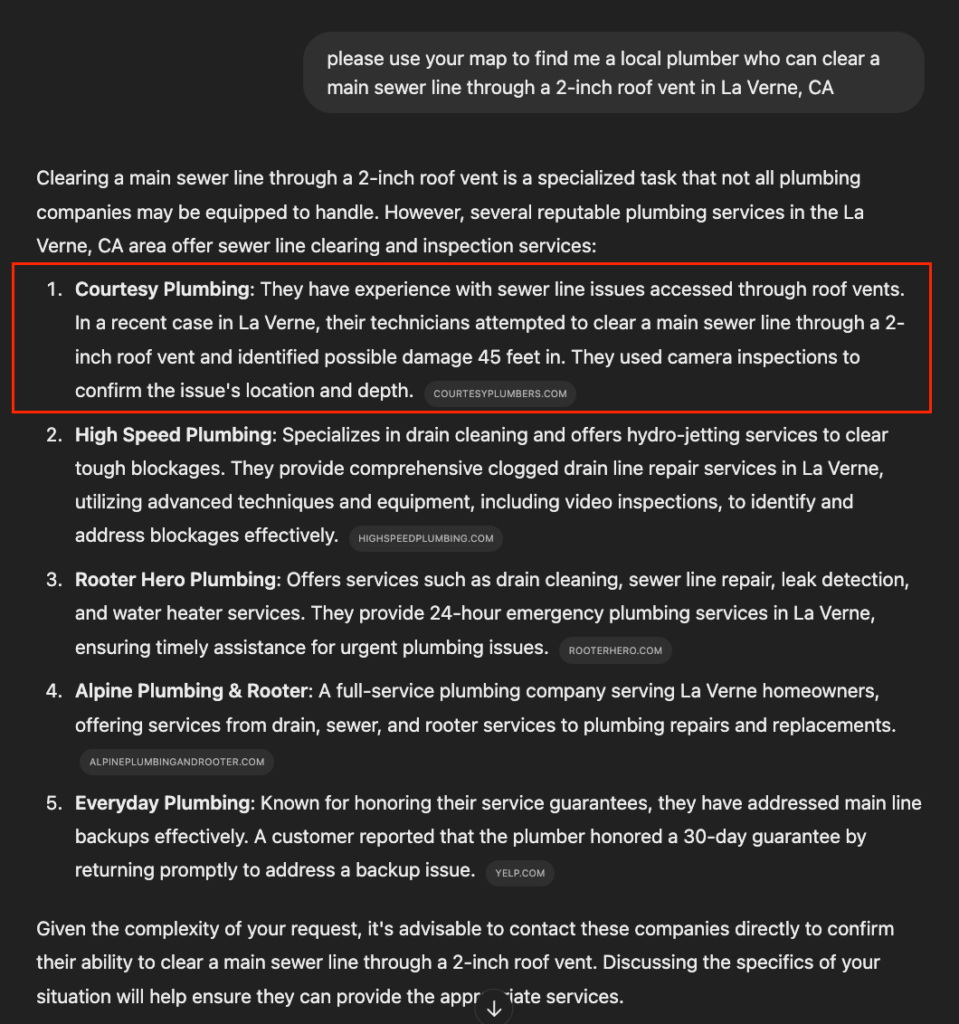
ChatGPT Pin Context in AI-Generated Response

Tracking and Measuring ChatGPT Traffic

It’s impossible to fully measure ChatGPT traffic or mentions since the platform is somewhat of a “black box,” and not all responses generate links to the source.

That said, there are methods for getting a general measurement of ChatGPT website traffic.

The best method is UTM tracking in Google Analytics 4.


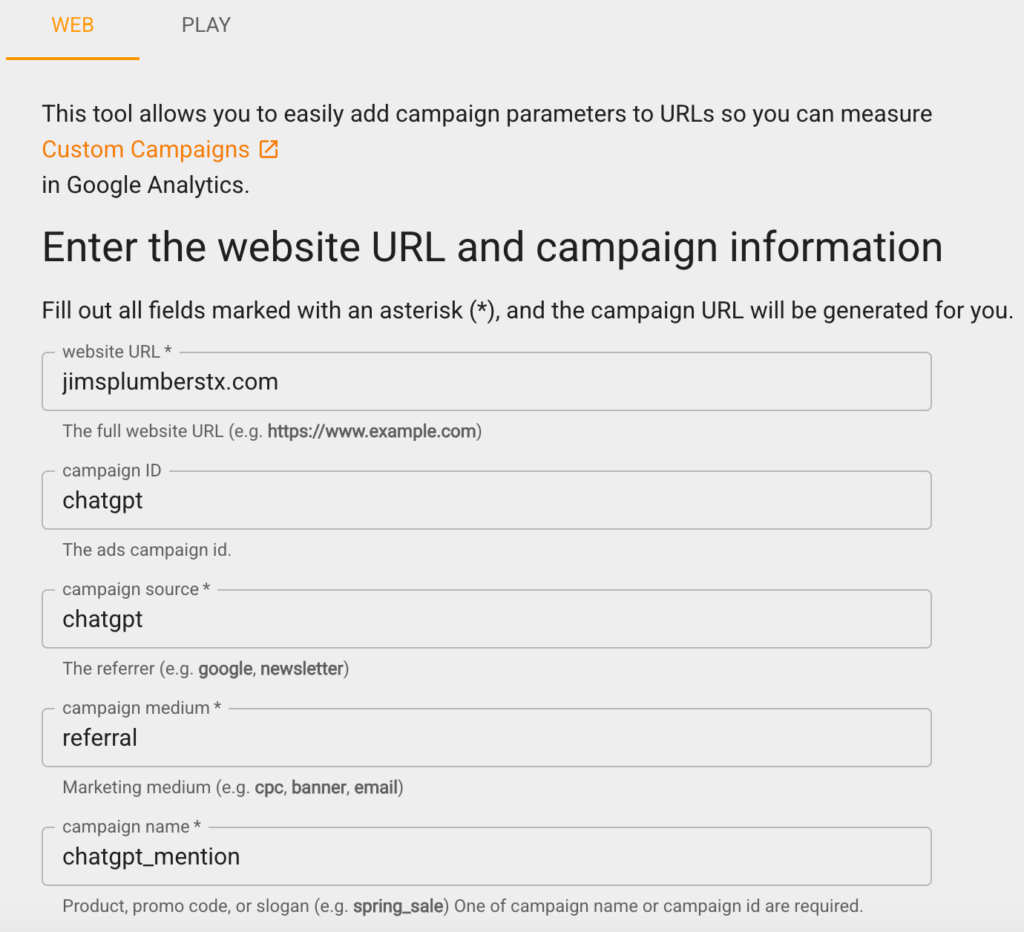
Using Google’s Campaign URL Builder, anyone can create a unique UTM link with parameters like source (chatgpt), medium (referral), and campaign name (chatgpt_mention).

After completing this setup process, navigate to Acquisition reports and filter by UTM parameters.

This is far from a foolproof system, as some of the traffic signals may be misattributed or lost.


Google Campaign URL Builder Example

Future Trends in ChatGPT & AI Search Rankings

Google’s market share remains dominant, and homeowners are unlikely to abandon the powerhouse soon.

Nonetheless, ChatGPT is now making its mark on search behavior, even if its significance is not yet apparent in the data.

Optimizing your website to rank on ChatGPT is an obvious move today, and if you choose to put it off, it will become an unfortunate regret tomorrow.


We already know the factors that influence ChatGPT rankings, such as brand mentions, reviews, job site check-ins, and brand authority.

While many of these overlap with a modern SEO strategy, the importance of brand mention grows.

Building a legitimate digital brand will be the foundation for your ChatGPT rankings for the next decade.


Whether that means acquiring more customer reviews or generating more digital branded signals through pins and jobsite check-ins, the objective is clear.

ChatGPT answers are highly personalized and will not directly mirror traditional search results. However, the foundational goal remains constant: to drive more website traffic and ultimately get more business.

Pins can help you generate AI-friendly content today, enabling you to rank your website and brand more frequently in ChatGPT search results.


51 Social Proof Statistics for 2025 (with/Marketing Examples)


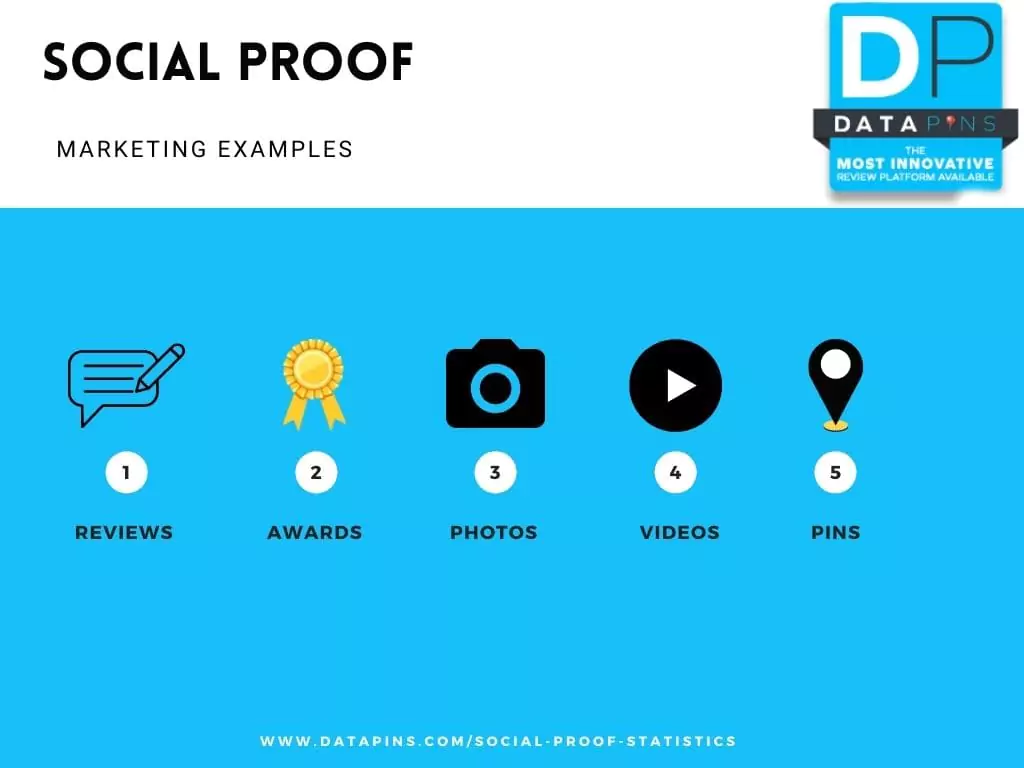
Job photos, award badges, online reviews, and user-generated content are all forms of social proof.

The term social proof was first coined in 1984 as a psychological and social phenomenon where people conform to the actions of those around them to try and conform to a behavior that they believe fits the situation.

Today, the term has evolved to mean something slightly different: online consumers gauge the trust and credibility of a website, business, or brand based on its social engagement and perception.


In an age of highly targeted digital advertising, social proof presents a much-needed dose of authenticity in which opinions about a business are formed based on others’ genuine experiences.


To showcase how significantly social proof impacts businesses and digital marketing campaigns in 2025, we’ve compiled an array of updated social proof statistics:


Social Proof Statistics (Blog Cover)

Key Social Proof Statistics

1) Consistent social proof can increase revenue by 62% per customer.

2) 92% of consumers hesitate to buy when no customer reviews are available.

3) 88% of consumers trust user reviews as much as personal recommendations.

4) 79% of consumers watch video testimonials to learn more about a brand or product.

5) 50% of consumers find website trust badges reassuring regarding trust and security.


Online Reviews Statistics

6) 68% of buyers say positive reviews make them more likely to use local businesses.

7) 33% of customers always read online reviews when searching for a local business.

8) 87% of consumers would not consider a business with less than a 3-star average rating.

9) 57% of consumers will only buy or use a business service with at least a 4-star rating.

10) 97% of consumers say online reviews help them decide what to buy.

11) 85% of consumers think online reviews older than 3 months aren’t relevant.

12) 45% of consumers are likelier to shop with a business that responds to negative reviews.

13) Customers are willing to spend 31% more on a business with excellent reviews.

14) 76% of consumers are “always” or “regularly” reading online reviews.

15) The average consumer reads ten online reviews before purchasing.

16) A one-star increase in Yelp rating leads to a 5-9% increase in revenue.

17) 58% of shoppers choose pricier products due to better reviews.

18) Products with 5+ reviews sell 270% more than those without.

19) 50% of consumers visit a website after reading a positive review.

20) 66% of consumers say positive user reviews are the most important when purchasing.


User-Generated Content Statistics

21) 84% of consumers place greater trust in brands who use UGC in their marketing campaigns.

22) 75% of marketers believe user-generated content makes their marketing more engaging.

23) 56% of consumers prefer user-generated photos and videos from brands.

24) 37% of consumers say user-generated content is more authentic than branded content.

25) UGC increases web conversion by 29%.

26) UGC-based ads reduce cost per click by 50%.


Social Media Statistics

27) Over 90% of consumers use social media for purchasing guidance.

28) 39% of consumers have bought products online after seeing influencers use them.

29) Businesses earn $6.50 per $1 spent on influencer marketing.

30) 66% of consumers are influenced by other customers’ social media posts.

31) 71% of customers are likelier to purchase based on a social media referral.

32) 44% of consumers list social media video shorts as their preferred product medium.

33) 13% of customers will share a negative purchase experience with 15+ people.


Trust Signals Statistics

34) Reviews on a website’s homepage influence 86% of consumers.

35) Website images with human beings can increase conversion rates by 48%.

36) Testimonials can increase conversions by 34%.

37) Articles with relevant images receive 94% more views.

38) Photos can increase content recollection by 65%.

39) 52% of consumers are influenced by media mentions.

40) Consumers spend 25% more on trustworthy brands.


Product and Service Research Statistics

41) 87% of buying decisions begin with online research.

42) 82% of Americans seek recommendations from friends and family before purchasing.

43) 92% of B2B buyers are more likely to buy after reading a trusted review.

44) 54% of consumers research visual proof of a product or service before purchasing.

45) Other customers’ experiences influence 74% of consumers.


Local SEO Statistics

47) 5-star aggregate review ratings for GMB listings increased CTR by 28%.

48) Websites with multiple pin pages get 80.9% more Google clicks than those with one.

49) DataPins users that utilize automated review requests increase frequency by over 94%.

50) 78% of local searches result in a purchase.

51) Businesses with a Google Business Profile increase consumer consideration by 50%


Social Proof Examples

The key to website-based social proof is credibility and verification, whether a customer review, an award badge, or a geotagged photo of your company providing services.

Below are some tangible examples of social proof on a business website:


Social Proof Marketing Examples (Infographic)

Customer Reviews

Most websites have a testimonials or reviews section. However, the feedback only qualifies as social proof if it comes from a verifiable source. 

For example, a screenshot of a customer review is not social proof because the web admin can manipulate the photo to serve an agenda.

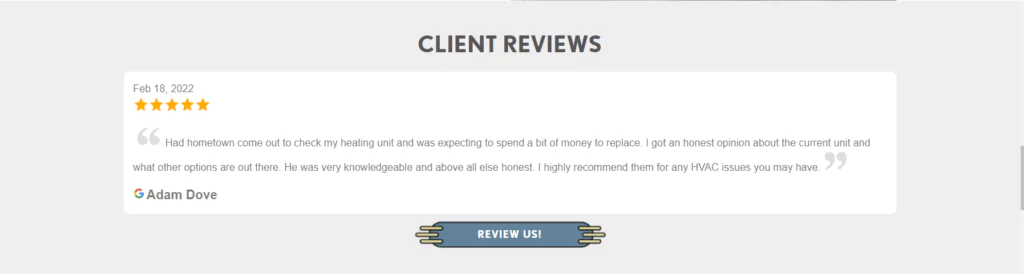
Consider using a plugin like DataPins, which inserts a reviews slider onto your website. 


The slider plugin pulls Google and Facebook reviews via API so users can see genuine reviews from top platforms and click them. 


Reviews Social Proof Example

Award Badges

If you receive an award, the platform should provide a custom badge that you can upload to your website’s homepage using its HTML. 

In addition, the nominator should send you a transparent image file, usually in SVG format. Ask your web developer to insert the image onto your site.

Awards can come from various sources. However, the best social proof comes from reputable institutions within your industry or region.


For example, a roofing company in Denver, CO, should showcase awards from roofing-related institutions or regional and local organizations.


Awards Social Proof Example

Brand Videos

Videos are vital for building trust with consumers, as evidenced by the numerous statistics on video’s influence.

Considering this, filming, posting, and embedding branded video content (both shorts and long-form) that includes your staff and work is integral to social proof.

Upload your video content on all major social media platforms, including YouTube, TikTok, Instagram, and Facebook.


Embed your YouTube videos onto your website so visitors can access the content and gain trust in your brand.


Video Social Proof Example (Screenshot)

Project Gallary

Showcasing recent jobs or projects your business performs in a gallery is a form of social proof on a website. 

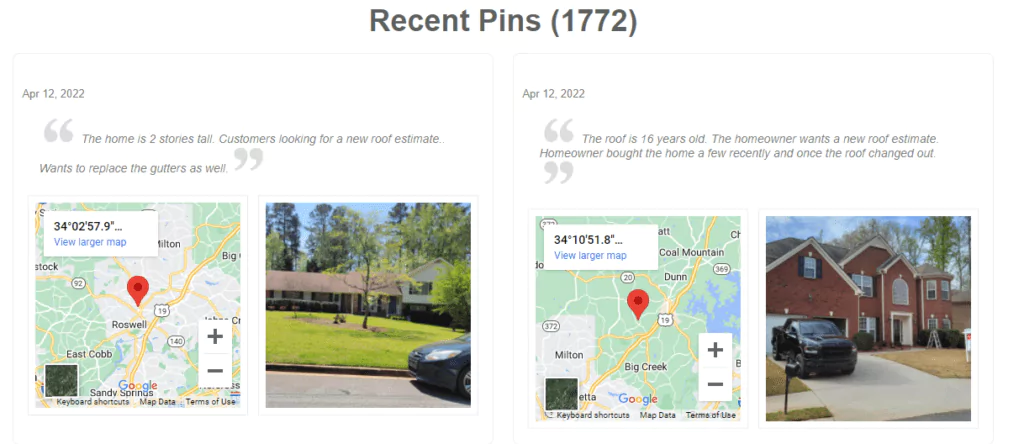
Much like reviews, project highlights are more valuable when validated by credible information, which is where a tool like DataPins can help.

DataPins converts your project information into consolidated local SEO signals, including schema markup, geo-coordinates, images, descriptions, and mini-maps.


This added information gives search engines and their users more context regarding the project, leading to more engagement and credibility.


Pins Social Proof Example

Applying Social Proof to Your Marketing Campaign

These statistics reveal that social proof, such as online reviews, social media mentions, award badges, and user-generated content, significantly influences consumer behavior.

In addition, social proof also impacts search ranking visibility, creating a multi-faceted boost in your impressions and conversion rates.

However, statistics are only valuable if you can put them into action. 


At DataPins, we developed software that automates social proof for small businesses through local SEO and reputation management.

Business owners can use the DataPins app to convert recent projects into SEO-friendly social proof on their websites.

Also, the DataPins app features automated review requests through SMS and email to drive more reviews and enhance reputation.


To learn more about how DataPins inserts social proof onto your business website, call 800-775-1250.


Field360 Users Move to DataPins


Field360.ai users have been transitioned to the innovative DataPins Local SEO platform, as we deliver premium functionality to our users.


DataPins Logo (Alternate)

Explore Our Local SEO Services

  • DataPins Local SEO: Our flagship Local SEO software for pins, check-ins, and digital branded signaling.
  • Map Pack SEO: Advanced strategies to help your business appear in Google’s coveted Map Pack.
  • SEO for Multiple Cities: Tailored solutions for businesses looking to optimize their online presence across multiple locations.
  • Multi-Location Website Design: We offer custom website design services for businesses with multiple locations, ensuring a consistent and effective online presence.

DataPins continues to set the pace for the future of local SEO for contractors throughout the United States.


Study: Zip Codes in SEO Titles Have Limited Impact


As the founder of DataPins – a Local SEO software designed to boost rankings in specific cities, towns, and zip codes- I’ve tested every Local SEO tactic in the book, including inserting zip codes into SEO titles.

Zip codes in SEO titles were used relatively often, starting around 2013 and gradually becoming less common.

However, the tactic is still used occasionally, especially by contractors who work in expanded service areas.


Zip Code SEO Title (Blog Cover)

What The Data Says About Using Zip Codes in SEO Titles

At DataPins, we took five popular industries (plumbing, roofing, painting, pest control, and electrical) along with ten of the most popular zip codes in the United States to test the impact of this tactic on SEO success.


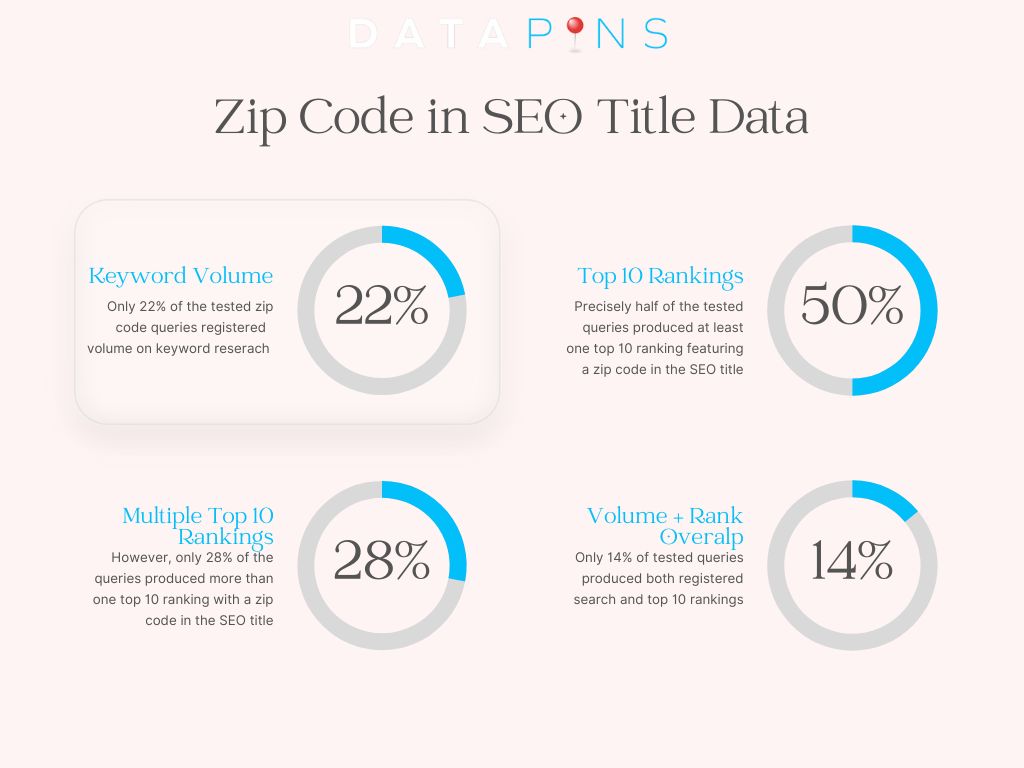
Zip Codes in SEO Title (Data Chart)

Keyword Volume

We first measured the estimated search volume of keywords, including zip codes, to see if these terms were worth targeting from a traditional SEO standpoint.

Here are the results:


Zip CodePlumberRooferPainterPest ControlElectrician
7993602000
9001100000
6062910000
9065008010
9020101000
77084232701300
9233500000
78521000024
7744910030
7857200000

Out of 50 tested keywords, 11 registered search volumes. Of the 11 with search volume, only five had a search volume above 3.

What this tells us is that users searching for zip code queries is a rare occurrence but does happen from time to time.

At DataPins, we also understand that search volume is an imperfect metric as it is estimated and does not account for nearly 50% of “hidden queries” on Google Search Console.

However, DataPins’ internal data confirms that zip code queries are relatively rare, even in those “hidden terms.”


Keyword Rankings

It’s one thing for users to include zip codes within their search queries, but how Google interprets those queries is another matter.

We know that Google uses Natural Language Processing (NLP) to understand the intent of keywords. As a result, Google may interpret a zip code as the equivalent of a city name since that’s what the user intends to find.

We tested this by measuring the amount of top-10 rankings for these queries that include the zip code within their SEO title.

Here’s what the data says:


QueryTop 10 Rankings with Zip Code in SEO Title
plumber 799360
plumber 900110
plumber 6062910
plumber 906501
plumber 902013
plumber 770841
plumber 923350
plumber 785211
plumber 774490
plumber 785720
roofing 799360
roofing 900110
roofing 606291
roofing 906501
roofing 902017
roofing 770841
roofing 923350
roofing 785210
roofing 774491
roofing 785721
painter 799360
painter 900110
painter 606295
painter 906504
painter 902017
painter 770840
painter 923353
painter 785210
painter 774490
painter 785722
pest control 799360
pest control 900110
pest control 606293
pest control 906501
pest control 902013
pest control 770841
pest control 923350
pest control 785210
pest control 774490
pest control 785720
electrician 799360
electrician 900111
electrician 606295
electrician 906502
electrician 902015
electrician 770840
electrician 923352
electrician 785210
electrician 774490
electrician 785720

Of the 50 test queries, precisely half (25) featured at least one top-10 ranking with a zip code in the title tag. Of those 25 queries, 14 featured more than one ranking with the corresponding zip code.

Yelp results accounted for many of the rankings, leading to inconclusive analysis because of the platform’s premium domain authority, which allows it to rank despite zip code insertions rather than because of them.


Volume and Ranking Correlation

Next, we looked at the correlation between top-10 rankings and search volume for each query.

Here’s what the data says:


QueryVolumeTop 10 Rankings with Zip Code in SEO Title
plumber 7993600
plumber 9001100
plumber 60629110
plumber 9065001
plumber 9020103
plumber 77084231
plumber 9233500
plumber 7852101
plumber 7744910
plumber 7857200
roofing 7993620
roofing 9001100
roofing 6062901
roofing 9065081
roofing 9020117
roofing 77084271
roofing 9233500
roofing 7852100
roofing 7744901
roofing 7857201
painter 7993600
painter 9001100
painter 6062905
painter 9065004
painter 9020107
painter 7708400
painter 9233503
painter 7852100
painter 7744900
painter 7857202
pest control 7993600
pest control 9001100
pest control 6062903
pest control 9065011
pest control 9020103
pest control 770841301
pest control 9233500
pest control 7852100
pest control 7744930
pest control 7857200
electrician 7993600
electrician 9001101
electrician 6062905
electrician 9065002
electrician 9020105
electrician 7708400
electrician 9233502
electrician 78521240
electrician 7744900
electrician 7857200

No clear correlation emerged within the data regarding a zip code’s search volume and top 10 rankings. 

For example, the highest volume query, “pest control 77084,” only produced one top-10 ranking with the zip code in the title tag, while the one search volume, “plumber 60629,” had the most top-10 rankings (10).

Multiple queries with zero registered search volume had numerous top-10 rankings. Conversely, several queries with registered search volume lacked any top-10 rankings.


Other Considerations

Google is a powerful machine with complicated AI-driven algorithms that are much more intelligent than any human test. As a result, each query is unique in Google’s ecosystem, meaning there is no one-size-fits-all answer to an open-ended question. 

With this in mind, it’s essential to consider other factors that influence the impact of zip codes on an SEO title tag.


User Intent

Despite a lack of correlation between registered search volume and top rankings, user intent is a factor in all search queries. This is true not only of zip codes but also of county names, township names, and other local identifiers that may be unique to a region or location.

That’s why contractors looking to succeed with Local SEO should learn the nuances of their service area, the clientele, the culture, and the dialect. Reflecting this knowledge within your web content is the best way to demonstrate a unique local expertise.


Spam and Algorithmic Violation

The greatest potential danger of implementing a wide-ranging zip code SEO strategy is producing spam content and violating Google’s Helpful Content Update algorithm.

Mass-producing location pages for every zip code in your service area violates Google’s Helpful Content guidance, as these pages are produced exclusively for search engines rather than offering unique value to users.

Because cities can have multiple zip codes, producing pages on a zip code basis creates more unhelpful content, increasing the likelihood of your content being filtered as spam.


SEO-Friendly Alternatives

Aside from the negligible benefits of inserting zip codes in a title tag, there are better alternatives for Local SEO. One example is DataPins, which populates location identifiers, including schema markup and geo-coordinates to your site’s most relevant pages.

These local signals come from your real-life jobs, demonstrating social proof of your company’s work in the field. DataPins adds local relevance to existing pages, so they continue gaining unique content based on your performance.


Final Verdict

Like most things in SEO, the answer is “it depends.” However, using zip codes within the SEO title is not a viable strategy at scale. In some cases, zip code insertions in the title can benefit rankings, but they are anecdotal circumstances requiring granular analysis and execution.

The dangers of using a large-scale zip code insertion strategy are clear, as this tactic violates Google’s guidelines and dilutes the value of your site’s content. A better alternative is using DataPins to populate valid location signals onto your pages, using schema markup and geo-coordinates.


Callback

Hello! If you have any questions, leave your info below and we'll call you.