Creating separate websites for each sufficiently distant service-based business location is not only the most effective strategy but also the one that Google recommends within its guidelines.
Their guidelines for representing your business on Google state the following:
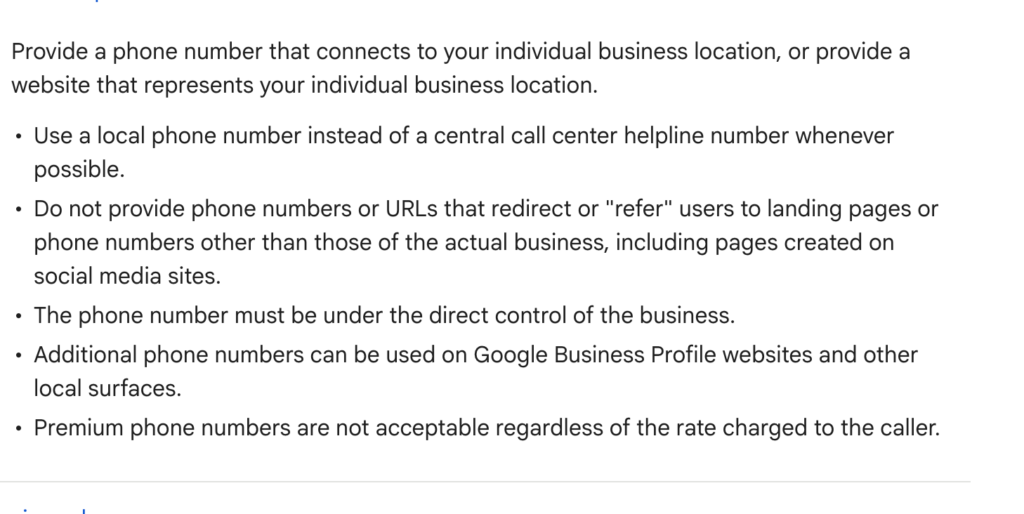
“Provide a phone number that connects to your individual business location, or provide a website that represents your individual business location.”
That language is quite clear: When adding a website to your Google Business Profile, it should represent the specific business location, not an interior page (location page) or subfolder for a website that primarily represents a different business location.

Despite clear guidelines about separate websites for separate locations, you would not reach this conclusion by speaking with an SEO expert, or asking Google’s AI Mode or AI Overviews for advice on this matter.
Why?
Because the SEO industry has long fed into a false narrative that subfolders and location pages are the only reasonable strategy for multi-location service businesses.
How The Wrong Practice Became “Mainstream” SEO Advice
Most people within the local SEO community recommend using a single domain for multiple service business locations.
When I say service businesses, I’m talking about plumbers, roofers, electricians, etc.
The reasons given by SEO professionals often overlap, citing consolidated backlinks, website authority, and brand consistency.
Google’s own AI Overviews will echo these sentiments by stating:

“For multiple business locations, it’s generally better to use a single website with dedicated, location-specific pages rather than creating separate websites for each location. This strategy unifies your brand, consolidates SEO efforts, and offers customers a consistent experience, while also allowing for local targeting through Google Business Profiles and localized content on your single”
This point of view is not limited to optimized articles on agency websites or even AI-generated responses that have synthesized those arguments. It also includes users on forums like Reddit.
One Reddit user even stated:
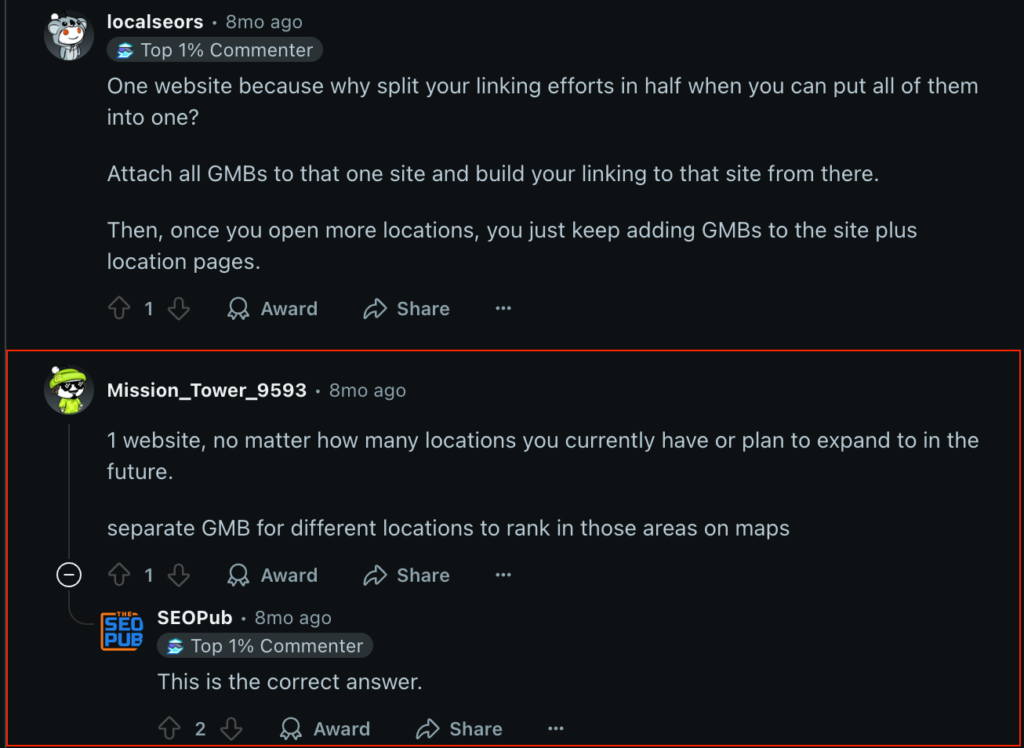
“1 website, no matter how many locations you currently have or plan to expand to in the future. separate GMB for different locations to rank in those areas on maps”
The Incentive of The Single Domain Status Quo
Unsurprisingly, none of the statements cited above, ranging from AI-generated responses to real Reddit users, cites any evidence or data for their findings, but instead frames them as an indisputable truth that is merely understood by those within the SEO industry.
You might ask why the industry is so adamant about a strategy that lacks supporting case studies or confirmation from Google officials.
Aside from the fear of “being wrong”, here are some of the SEO industry’s other possible reasons for perpetuating this myth:
Agency Profit and Scalability
Money always talks, and it’s easier for an agency to measure, manage, and itemize work on a single website than to create, optimize, and manage multiple websites.
Spam Misconceptions
There’s a distorted fear within the industry that creating multiple websites is seen as “spam.”
This fear is especially ironic because the strategy they recommend (mass-producing location pages) is prohibited by Google’s guidelines, which allude to these types of pages as doorway pages.
Hard to Explain
When selling to a business owner, and a SAB in particular, it’s easier to keep things simple than to help them succeed.
Many clients don’t understand why they need multiple websites, and it’s an easier sale just to let them target every location on one website.
Misunderstanding of Link Equity
Agencies want to be able to show their clients a significant domain authority, domain rating, or other 3rd party metric that makes their website “seem” authoritative without providing the nuanced explanation of how the local context of a backlink has a greater influence on rankings and traffic than a singular metric.
Misunderstanding of Vector Embeddings
Most SEOs don’t know what vector embeddings are or how a site’s core site vector becomes diluted when adding content (including local content) that does not align with the primary topic or location.
Reasons to Create a New Website for a New Service Location
Simply refuting the claims of the broader SEO industry is insufficient for challenging their general premise, that all service locations should be nested under a single branded domain.
There are profound reasons why creating separate websites for separate locations is beneficial to success.
1) Local Link Context
The notion that domain rating or authority can be viewed as a single number within a local context is fundamentally flawed.
As Mike King of iPullRank, one of the most technically-focused SEO professionals, stated:
“We’ve learned that, where the pages that link to you sit in the different levels of the index impact how much authority that they pass. But every link index is still using the same metrics that they were using, for the last 15 years.”
Achieving your 60+ domain rating on a local plumbing website might help you market your agency, but it is unlikely to help that plumber rank and grow their business.
The context of local links matters more than the volume. For instance, a San Diego chamber of commerce link to a Los Angeles-based plumbing company lacks the potency that it would have for a San Diego-based plumbing company.
The further away your locations are from one another, the more irrelevant your backlinks become in a local context.
That Little League sponsorship link you received for your Dallas-based roofing company’s homepage suddenly becomes confusing in relation to your Atlanta location page after you expand your roofing business across state lines.
Conversely, suppose you create an entirely new website for that Atlanta location. In that case, you can then seek out the Atlanta-based sponsorship link to maintain a clean, relevant, and influential local link profile.
2) Vector Embeddings
Keyword research tools like SEMrush and Ahrefs don’t operate the way Google and, especially, Google’s Gemini and its AI tools do today.
Vector embeddings are like consolations in space; they represent semantic distances from one topic to another.
Each local service website has a core site vector, such as electrician seattle. When you start adding pages about roofing or Minneapolis, you dilute that site vector, potentially reducing your rankings, clicks, mentions, and citations.
Vector embeddings are not the only SEO or GEO ranking factor, which means adding such pages is not an automatic “death sentence” to your digital marketing efforts.
However, doing so is far from a best practice. It can significantly hinder or diminish your progress if not outweighed by other weighted factors, such as brand authority, reviews, internal linking, and content quality.
That’s why when SEOs celebrate one of their clients’ service websites ranking across state lines, they are fundamentally misunderstanding the variables that are resulting in those rankings.
To put it simply, those websites are not ranking because of their SEO strategy but rather despite it.
What most within the SEO industry don’t realize is that many of the highest-ranking websites are not perfectly optimized; they simply have advantages that SEO practitioners cannot influence, such as offline popularity or strong brand recognition.
If SEO practitioners used best practices, such as creating a new website for a new service location, they would further increase that company’s business and profitability.
Instead, they celebrate the “results” that the SEO practitioner had nothing to do with and cite them as evidence as to why their strategy works.
However, when dealing with smaller businesses that lack those built-in advantages, understanding core site vectors and engaging in best SEO practices are exceedingly more crucial to their success.
When a Single Domain Strategy Makes Sense
In some cases, a single-domain strategy is not only appropriate but also optimal, such as for enterprise-level brands with a strong national presence and storefront-based businesses.
A single domain strategy works for enterprise-level brands when these conditions are met:
- The brand garners national trust and recognition
- The user intent is brand-first, instead of service-first
For example, when users search for a well-known brand like Home Depot, they don’t expect or require a distinct website for each location.
Instead, they expect to find a central brand domain that routes them to a local store through a subfolder or a store locator.
The same concept applies to brands like Target, AT&T, and Starbucks, as users are not searching for a query like “coffee near me” but rather the specific brand.
The key difference is that these brands are not service area businesses (SABs), such as plumbers or roofers.
The single-domain logic breaks down for local contractors, as users expect a local service.
Google understands the differences, and the businesses themselves need to know how Google views their specific business.
The Distance Variable for SABs
Another case in which a single domain is optimal for a local SEO campaign is when a business has multiple locations within a confined radius.
For example, a local plumber who has two verified Google Business Profiles in the same zip code should not create a second website for the second GBP.
Their website already targets the city in which both profiles are verified, meaning their website satisfies the user intent for both Google Business Profiles.
A separate website typically becomes optimal when your business location is 51 miles or further from your primary location.
The precise distance may vary by market, as some rural areas have a wider search radius (from the user’s perspective) than metropolitan areas.
Final Verdict: Multiple Websites are Often Necessary for SABs
Despite an echo chamber of misinformation, Google’s guidelines plainly recommend having individual websites for each distinguishable service location.
While blindly adhering to Google’s guidelines without testing is unwise, the most innovative and trustworthy SEO voices have also introduced concepts that support creating multiple websites for service area businesses with numerous locations that span a wide service area.
Understanding how vector embeddings influence search results, link context, and AI responses helps contextualize the nuance of service area business websites for multiple locations.
The broader takeaway from this is that things considered “best practice” within SEO communities have often gone untested and are perpetuated for reasons unrelated to objective performance.
As a result, testing your own unproven theories is the best way to confirm or debunk them so your business can succeed.