The emergence of AI platforms like ChatGPT and Perplexity AI has leveled the playing field for businesses whose Google rankings were failing to yield consistent or reliable clicks.
While Google remains the most widely used platform for finding businesses, new tools like ChatGPT and Perplexity AI are attracting an increasing number of users.
Perplexity AI currently has more than 15 million active monthly users, resulting in over 100 million search queries per week.
Based on these numbers, all local businesses serious about digital marketing should invest effort in optimizing their company, website, and brand for Perplexity AI.
Key Takeaway
Perplexity AI optimization focuses on topical relevance and trust, as these factors enable businesses to appear in results after undergoing the platforms’ retrieval and augmented generation process.

How Perplexity AI’s Algorithm Works
Perplexity AI is a hybrid of a traditional search engine and a modern large language model, combining to produce concise and cited answers that consistently satisfy the user’s intent.
Hybrid Architecture
Perplexity AI uses a hybrid architecture that combines traditional keyword-based search with modern vector-based search.
Their algorithm retrieves documents that directly match the user’s query, as well as documents that are semantically similar but do not have an exact match to the query.
The end result provides users with the best of both worlds, yielding results that consistently satisfy their search queries.
LLM-Powered Query Analysis
Perplexity AI distinguishes itself from other search tools with LLM-powered query analysis, utilizing the power of a large language model to analyze the intent behind each query.
Through LLMs, Perplexity AI can reformulate and expand queries to find topically relevant sources that would not have been retrieved with traditional search engines.
Perplexity AI can then rank and filter these retrieved documents before the summarization process.
Retrieval Augmented Generation (RAG)
RAG is essentially a three-step process in which Perplexity AI retrieves documents based on the user’s query (retrieval), runs those documents through an LLM-powered fact-checker (augmentation), and delivers a final response (generation).
Instead of answering based on memory, Perplexity AI generates a response by referencing the retrieved documents via grounded generation.
From there, it delivers citation-based responses that include numbered sources with direct links to their referenced web page.
Iterative Reasoning
For specific queries that have a higher level of complexity, Perplexity AI is able to break them down into sub-questions, similar to Google’s fan-out queries, and retrieve multiple layers of information.
Perplexity then synthesizes a final response based on all the information and analysis it has gathered.
Citations and Trust
Linked citations are at the core of Perplexity AI’s appeal, as it directly cites a web-based source for every answer it generates.
This presentation instills a sense of trust, even more so than AI platforms like ChatGPT, which often fail to cite sources in their responses.
As you might imagine, Perplexity AI’s algorithm attempts to cite reliable sources that demonstrate credibility online.
How To Optimize for Perplexity AI’s Standards
Since we know that each query undergoes a three-step process called Retrieval Augmented Generation (RAG), the basis of our optimization becomes meeting the standards of this process.
We can achieve this by creating topically relevant content that can be easily retrieved and building sufficient trust and credibility to withstand the augmentation process.
Creating Retrievable Content
Creating retrievable content aligns closely with traditional SEO strategies such as high-quality content writing, title tag optimization, and keyword targeting.
For businesses whose websites are already optimized for Google search, your content already has a moderate to high chance of getting retrieved for relevant queries of a reasonable difficulty.
Still, there are measures you can take to further increase your retrievability, such as DataPins, which injects content based on your actual jobs.
Surviving Post-Retrieval Augmentation
Traditional SEO may be enough to get your web page retrieved, but it is insufficient for surviving the next phase of the process.
During this phase, your content will be graded more harshly. For instance, the LLM will cut through all the fluff and jargon, which are typical tenants of “SEO” blog posts.
It breaks down your web page into chunks and looks for key facts that are concisely answered in an NLP-friendly format.
It also verifies entity-based credibility through elements such as names, places, dates, results, and evidence.
Essentially, the augmentation wants to build confidence that your information is reliable enough to be cited in its final response.
This is where a tool like DataPins helps, as it generates that entity-based credibility for each job, increasing the confidence of each page.
Examples of Perplexity AI Rankings and Responses
Local Roofing Company
A local roofing company in Rochester, NY, used DataPins to secure the #1 citation and mention within a highly relevant Perplexity AI query.
The company had a dedicated web page for the service, which enabled simple content retrieval, and they utilized DataPins to facilitate the augmentation process.
Perpexity also synthesized their Yelp listing as part of the final response, which shows the importance of business listings on credible platforms like Yelp, Google, and Facebook.

Local Plumbing Company
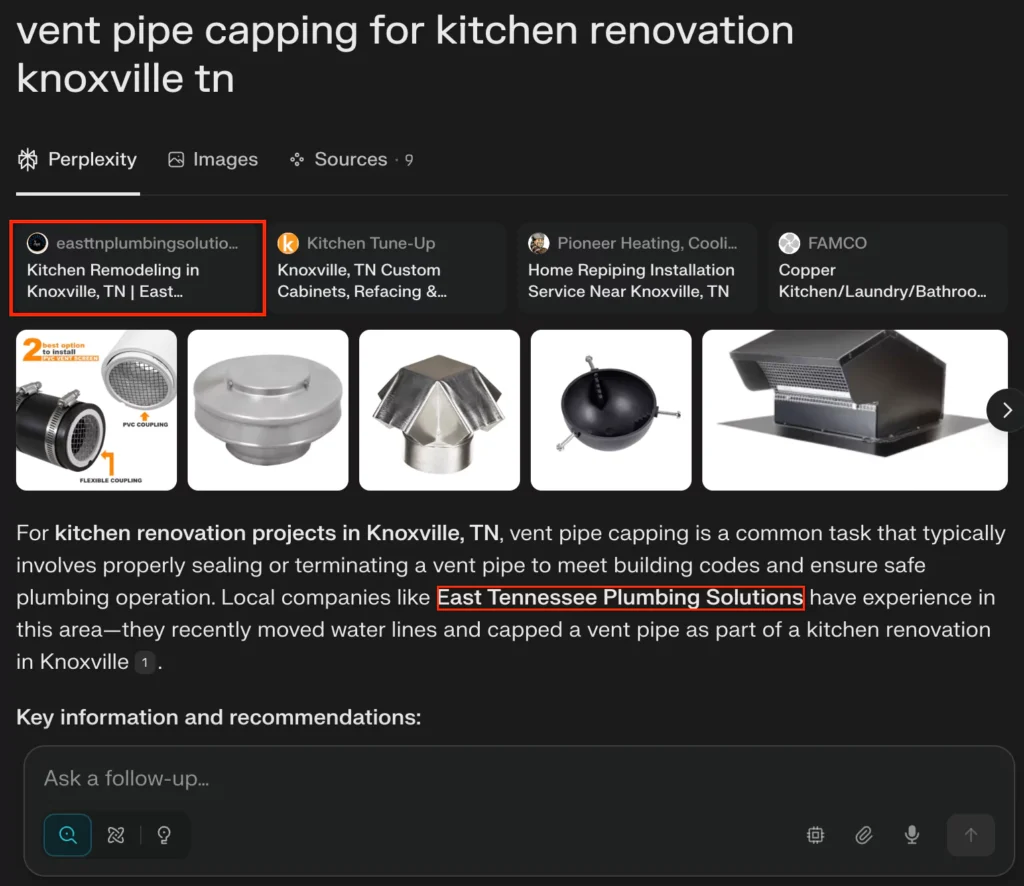
A local plumber secured the top citation and mention within Perplexity AI for a hyper-specific query that reveals the power of Perplexity’s LLM-powered algorithm.
While their website had a page about a related topic, it also included a DataPins check-in for the specific sub-service highlighted in the query.
During the augmentation process, Perplexity pulled this “chunk” of the web page and graded ig highly enough to be the top response and citation.
Local HVAC Company
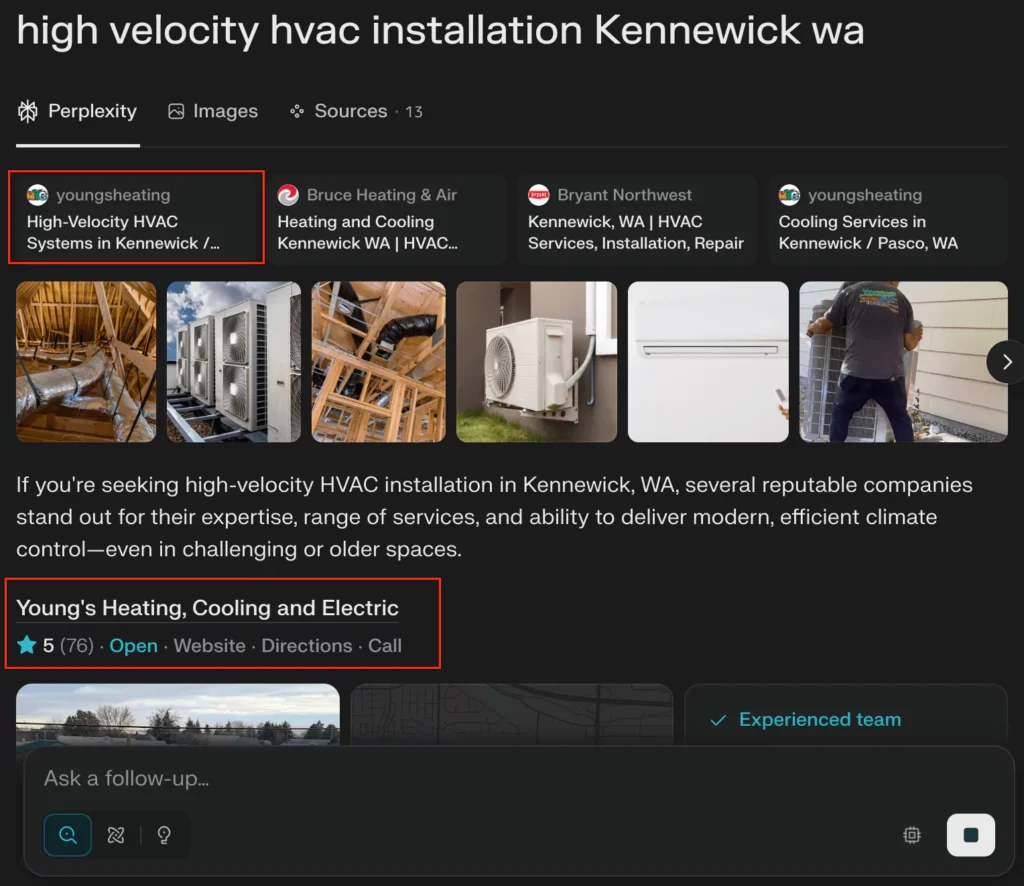
A local heating and cooling business in Washington with DataPins installed on their website received the top citation and mention in Perplexity AI for a specific HVAC-related query.
This website also had a dedicated page for the service, and Perplexity once again synthesized their Yelp listing as part of the final response.
This example reinforces the importance of digital brand signals across the web for maximizing AI visibility online.
TL;DR – How to Rank in Perplexity AI
The first step is to use short NLP-friendly sentences on dedicated web pages to gain retrieval eligibility in Perplexity AI’s algorithm.
The next step is to inject entity-based credibility signals into your content using tools like DataPins and by showcasing award badges and other notable recognitions.
If you take both of these measures, you have a great chance of optimizing for Perplexity and bringing in new customers from this platform.